A focused text field raises the keyboard: board evidence
Change: a-focused-text-field-raises-the-keyboard. Evidence class: board,
injected touch and keys through /var/tmp/ui.py, native grim. Not glass,
and not the real base, so suppression (3.5) is not exercised: injected keys
come from a uinput keyboard, not keyboard-base.
Build /nix/store/kllh24ww1vhybcdf6z9z6jz859584jsb-nixos-system-nixos-26.11.20260919.20b1ddd
(commit b351d40a), test-activated, 2026-10-27 ~03:50Z.
board/terminal-focus-keyboard-up.png: the terminal took focus and wvkbd rose. Cropped to the keyboard; the terminal text is left out.board/overview-keyboard-lowered.png: LILYGO+Tab (injected) with the terminal focused. The keyboard is down and the card is full size. On buildvzizj58r…, before the compositor lowered it, the same step left the keyboard up and the card crushed above it.wayland-infolistszwp_input_method_manager_v2andzwp_text_input_manager_v3;shell-osk-focusis active, and its journal has nounavailableline.
Not yet run: a GTK entry (3.3), flapping while typing (3.4), suppression after a base key (3.5) and key integrity (3.6).
Touch-only terminal apps (build iw96wr9d…, commit 93dc4efb)
On build kllh24ww… focusing the Timer raised the keyboard over its
buttons. With focusKeyboardIgnoreAppIds, board/timer-focus-keyboard-down.png
(2026-10-27 ~15:19:55Z) shows the Timer focused and running with the
keyboard down, and a terminal launched the same way still raised it.
GTK4 entry did not raise the keyboard (task 3.3, failed on zs05li2k…)
Tapping the Files search entry focused it (“Search everywhere”) but the
keyboard stayed down (board/gtk-search-no-keyboard.png, 2026-10-27
~16:55Z). A WAYLAND_DEBUG=1 trace of Nautilus
(board/gtk-late-text-input-trace.txt) shows the cause: GTK4 creates its
zwp_text_input_v3 only after the first touch has already moved keyboard
focus to it, Sway sends enter only on focus changes, so GTK’s enable
arrives for a text input with no focused surface and wlroots ignores it.
Foot creates its text input at startup, which is why the terminal works.
nix/patches/sway-k230-text-input-late-enter.patch sends enter when a text
input is created for the client that already holds keyboard focus. Task 3.3
stays open until a build with the patch raises the keyboard for the entry.
GTK4 entry with the Sway patch (task 3.3), build gpgh1vx6… (commit e8056ece)
Board, injected touch and keys, native grim, 2026-10-27. Files launched
from the Home dock as usual (no tracing). board/gtk-search-keyboard-up.png:
Home, Files open, the search button tapped at 17:01:46Z with the entry focused and
the keyboard up, then a tap meant for the file area that landed on the raised
keyboard’s “h” key and typed “h” into the entry. board/gtk-search-closed-keyboard-down.png:
Backspace emptied the entry, GTK closed the search bar and the keyboard went
down; Starred then opened by touch at 17:02:15Z with the keyboard still down.
shell-osk-focus logs nothing on show/hide, so its journal only shows the
restart; the captures are the record. A GTK3 entry was not tried.
foot while typing: no flapping (task 3.4), build gpgh1vx6…
shell-osk-focus writes nothing per show/hide, so the journal cannot show
flapping. Instead board/kbwatch.py.txt (run as /var/tmp/kbwatch.py 100)
blocks on inotify and prints each replacement of
/run/shell/k230-keyboard-visible, which k230-keyboard-gesture-signal
rewrites on every show and hide call, from any caller. Log:
board/foot-typing-kbwatch.log; captures: board/foot-typing-no-flap.png.
From Home the dock’s terminal was tapped at 17:06:13Z: one show. Then 26
keys (“echo flap test one two three”) typed through the injected uinput
keyboard between 17:06:17Z and 17:06:23Z, plus Enter: no events, and the
line echoed intact. Switching to the overview at 17:06:25Z gave hide, and
tapping Home at 17:06:28Z a second hide. The keys came from the injected
uinput device, not the base or the on-screen keyboard, so 3.5 and 3.6 remain.
Base attached: no keyboard on focus (task 3.5), 2026-10-28 23:02–23:04
Build vf91pbq6…, test-activated, with the shell restarted and shell-idle
stopped. Evidence class: injected (ui.py uinput touch, plus a uinput
keyboard that is not the base) with native grim captures. The base’s
tca8418 was listed in /proc/bus/input/devices. No base key was pressed
after the shell restart: k230-keyboard-base-last-key did not exist, so the
10 s rule could not be what kept the keyboard down. The visibility marker
/run/shell/k230-keyboard-visible was read after each step.
| Step | Result | Capture |
|---|---|---|
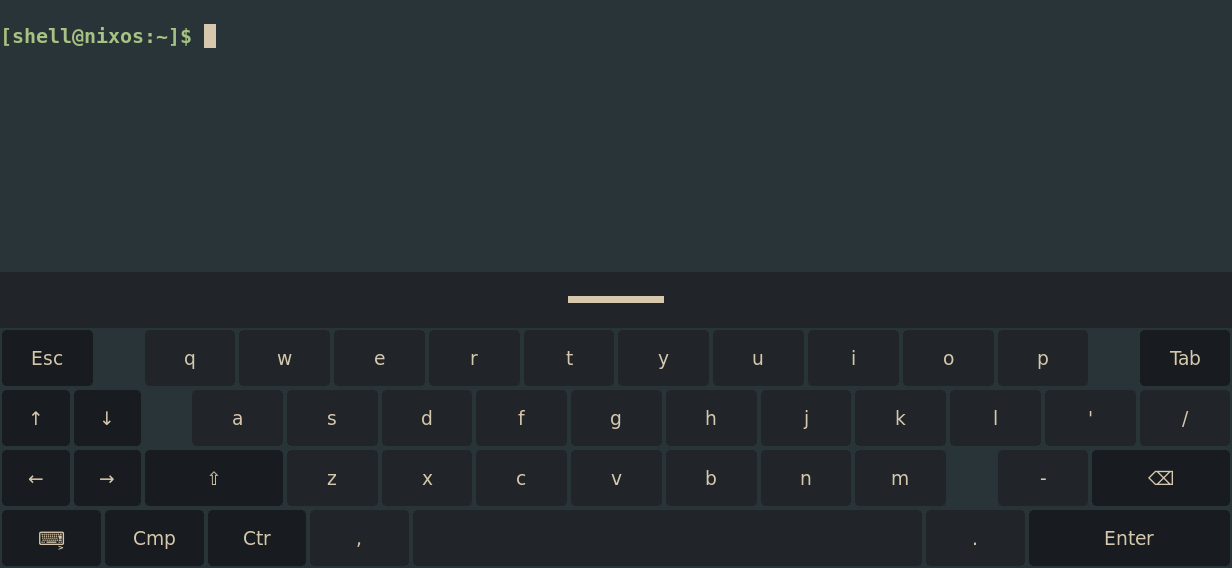
| Drawer, tap the search field | Cursor in the field, no keyboard; injected F, I, L typed “fil” and listed Files | drawer-tap.png, drawer-typed.png |
| Terminal opened from the drawer, tapped | foot focused, no keyboard; marker still hide from 23:02:34 | terminal.png |
| Two-finger swipe up from the bottom edge | Keyboard rose; marker show at 23:03:38 | gesture.png |
| Files, tap the search button (GTK4 entry) | Entry focused, “fil” typed, no keyboard; marker still hide from the handle swipe at 23:04:02 | gtk-typed.png |
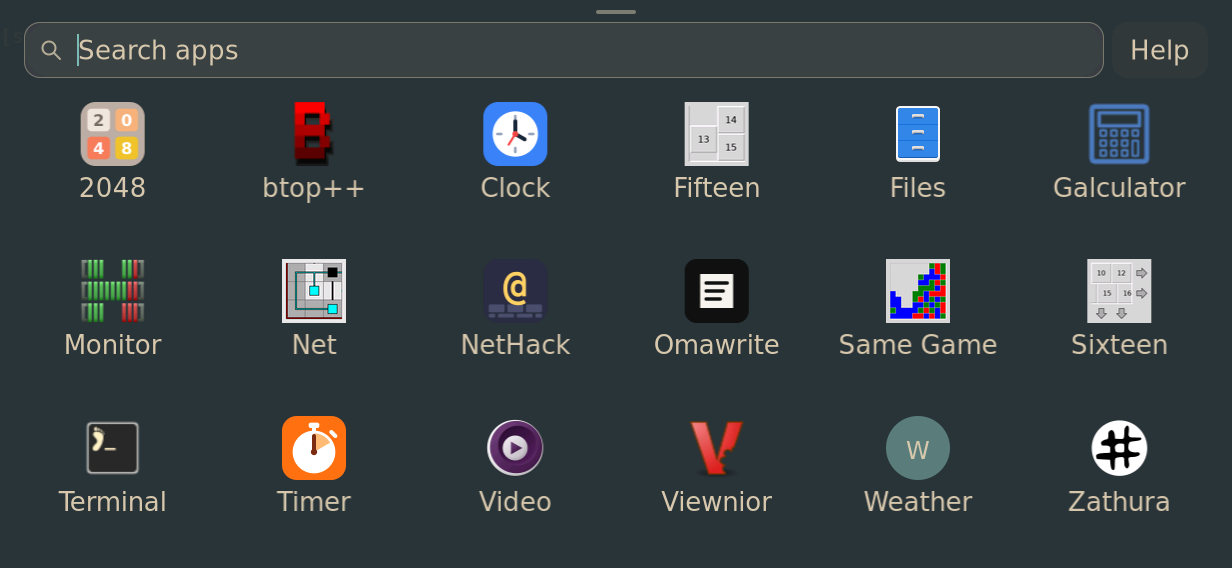
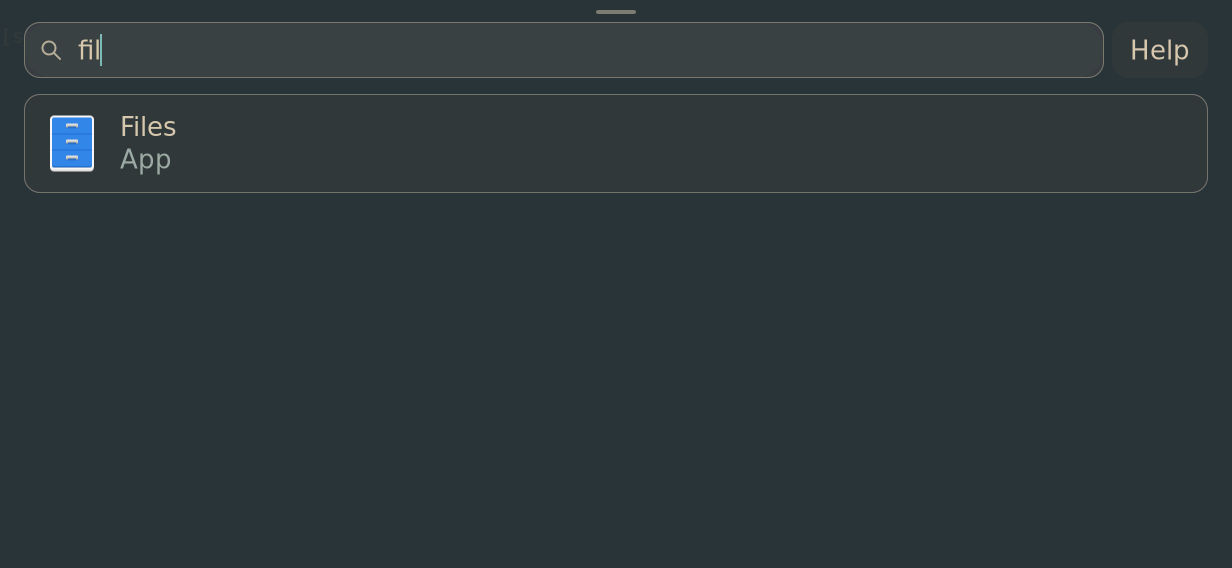
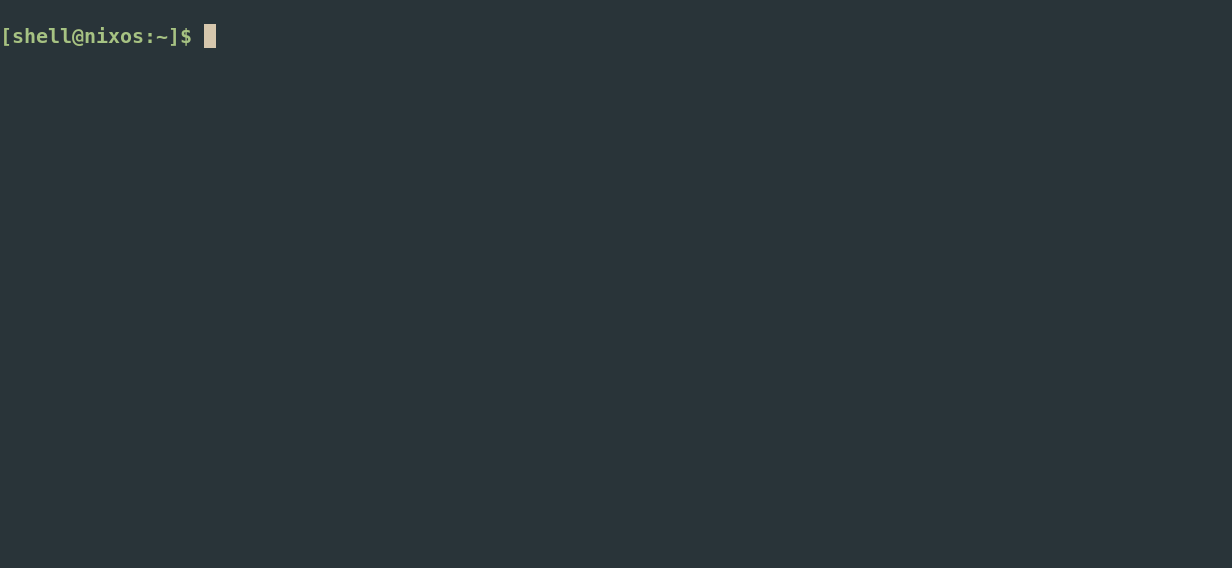
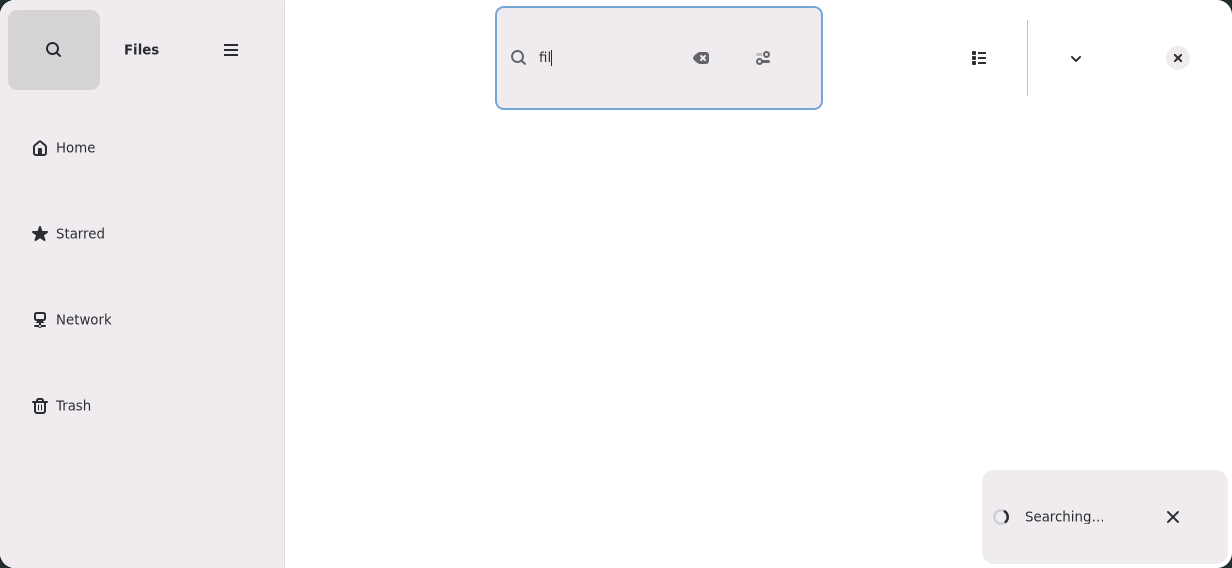
Limits. The keys came from an injected keyboard, not from the base’s matrix. There is no same-build control without the base, because the base cannot be detached in software. Before this rule, 3.3 and 3.4 showed the same fields raising the keyboard.
Operator report. After this deploy the operator, who had first reported the keyboard rising over the drawer search with the base attached, tried it again on the glass and replied “worked great” (2026-10-28). That is a glass report without detail: it records no field list and no typed text.
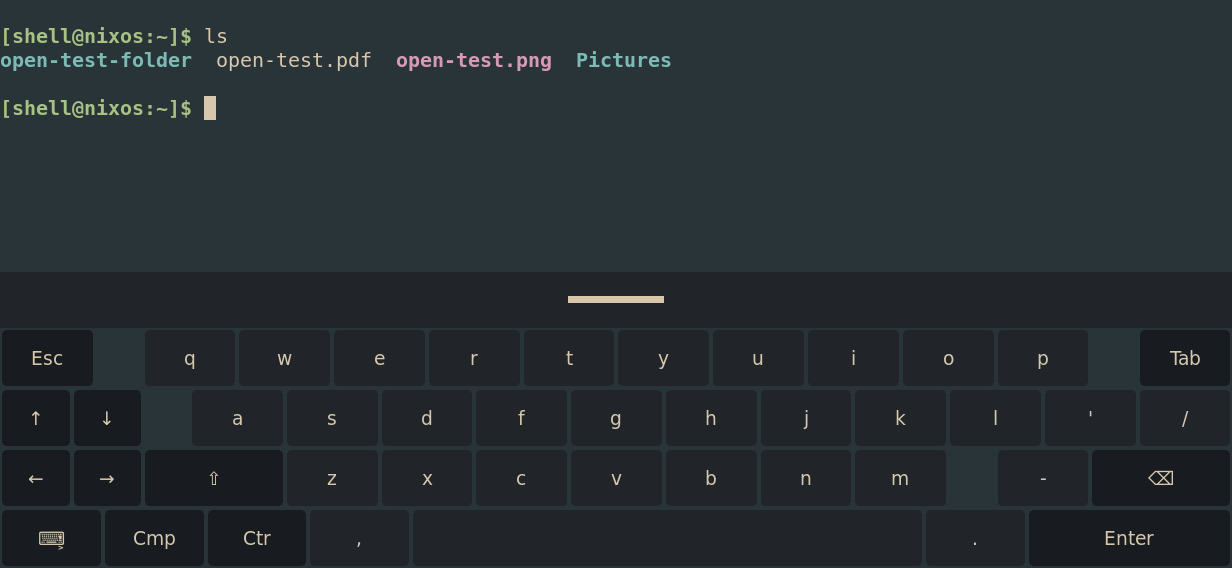
On-screen keyboard typing (task 3.6, glass half), injected. On the same
build with the base attached, a terminal was opened from the drawer and the
keyboard raised with the two-finger swipe. Injected taps on its l, s and
Enter keys ran ls, which listed the home directory, and the keyboard stayed
up throughout (osk-typed-ls.png).
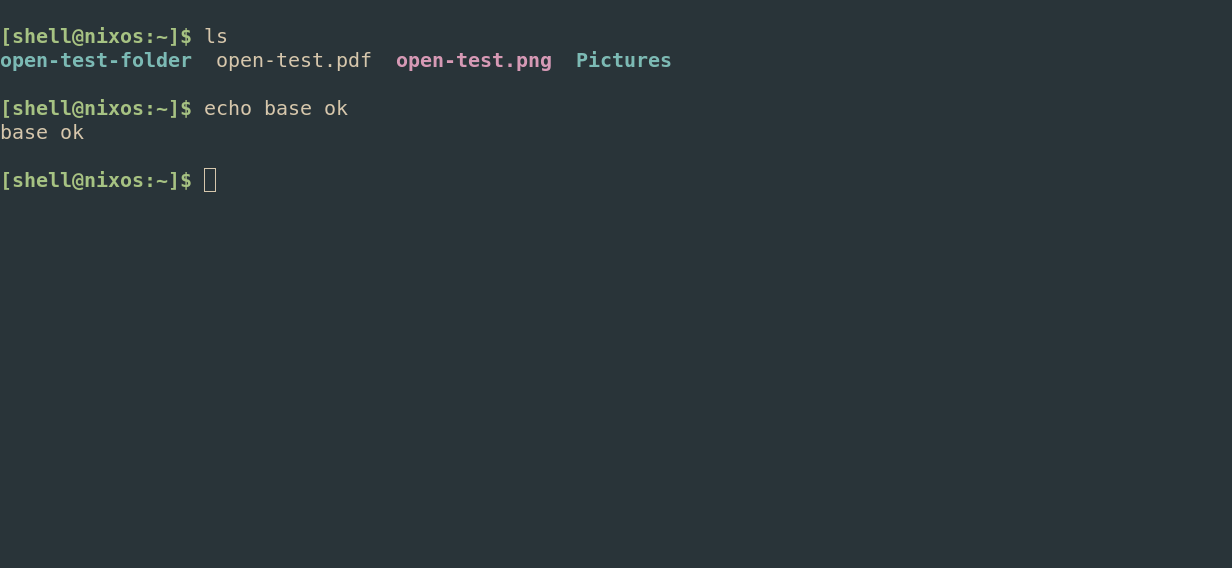
Base typing (task 3.6, base half), operator at the glass. On the same
build, asked to type echo base ok on the base in Terminal and press Enter,
the operator confirmed that it printed base ok exactly (“yup”, 2026-10-28).
This rests on the operator’s report; no capture was taken.
A later native grim of that terminal
(base-echo-terminal.png,
2026-10-28 ~23:40) shows echo base ok followed by the line base ok, as
the operator reported.