Big Buck Bunny software streaming trial
This is a bounded playback baseline for the K230 shell. It does not claim a production video player, sustained 30 fps, audio support, or hardware decode. The board was operated by the primary agent; this evidence audit used only the provided transcripts and media.
Source and attribution
The stream was the public Akamai DASH manifest
https://dash.akamaized.net/akamai/bbb_30fps/bbb_30fps.mpd, using Big Buck
Bunny. The film is the Peach open movie by the Blender Foundation and is
licensed under Creative Commons Attribution 3.0; attribution is retained here:
(c) 2008 Blender Foundation / www.bigbuckbunny.org,
official project attribution.
The trial worktree was at source commit 45e5e1a (Add a bounded software video probe and quiet radio logging). Playback used the target’s RISC-V mpv
derivation with --vo=wlshm --hwdec=no --audio=no; the 270p launch also used
--profile=sw-fast, --vid=6, --start=45, --length=30, and a 568x320
window. Audio was intentionally disabled. The source was remote DASH, so these
results include network/cache behavior.
Results
The 640x360 trial selected H.264 video stream 7 (30 fps, 1255 kbps) and used
wlshm software output. It recorded zero decoder drops and 509 video-output
drops by the end of the bounded roughly 40-second observation, when playback
was at about 1:09. The bounded run ended with Exiting... (End of file) after the requested
40 seconds; a concurrent DASH read reported Immediate exit requested during
shutdown. This is a
software-rendering stress result, not a claim that 360p is smooth.
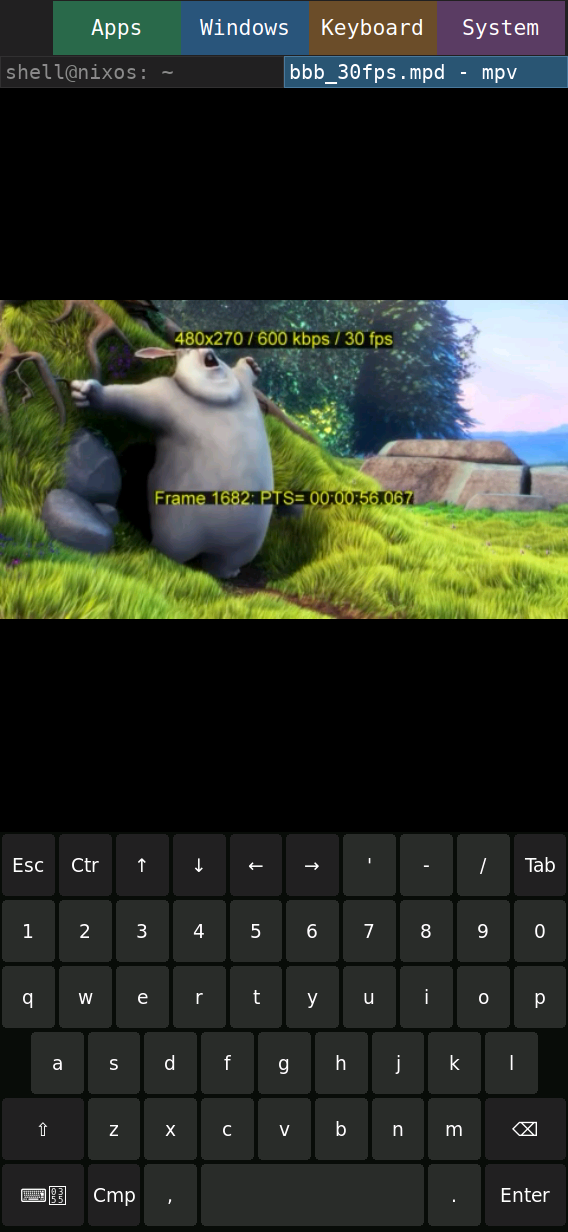
The final 480x270 trial selected H.264 stream 6 (30 fps, 760 kbps), again with
software H.264 and wlshm. It reached about 1:14 with 0 decoder drops and
106 video-output drops, and a final demuxer cache of about 96.97 seconds. The
native screenshot 270p-native.png shows the decoded frame,
launcher bar, terminal title, and keyboard.
The tested boot had only CPU 0 online and present. The CPU probe captured four
complete process snapshots. CLK_TCK=100 and PAGESIZE=4096 were verified through
the board console. Raw /proc samples are preserved in
270p-cpu-console.txt. Across the recorded interval,
mpv advanced from 851 to 1,134 user ticks and 99 to 111 system ticks; Sway
advanced from 650 to 740 user ticks and 86 to 93 system ticks. Using the
recorded timestamps and CLK_TCK=100 gives a rough sampled average of 57% mpv,
19% Sway, and 76% combined CPU occupancy; this is an interval estimate, not a
scheduler or whole-system benchmark.
The 270p status and the 360p status are preserved with terminal control sequences removed in
270p-final-status.txt and
360p-status.txt. The automated 270p physical camera trial
was inspected before selection. The four-second cropped clip and still contain
only the device display and no legs or other private scene content:
270p-physical-clip.mp4 and
270p-physical-frame.jpg. The crop was made from
camera.mp4 with ffmpeg:
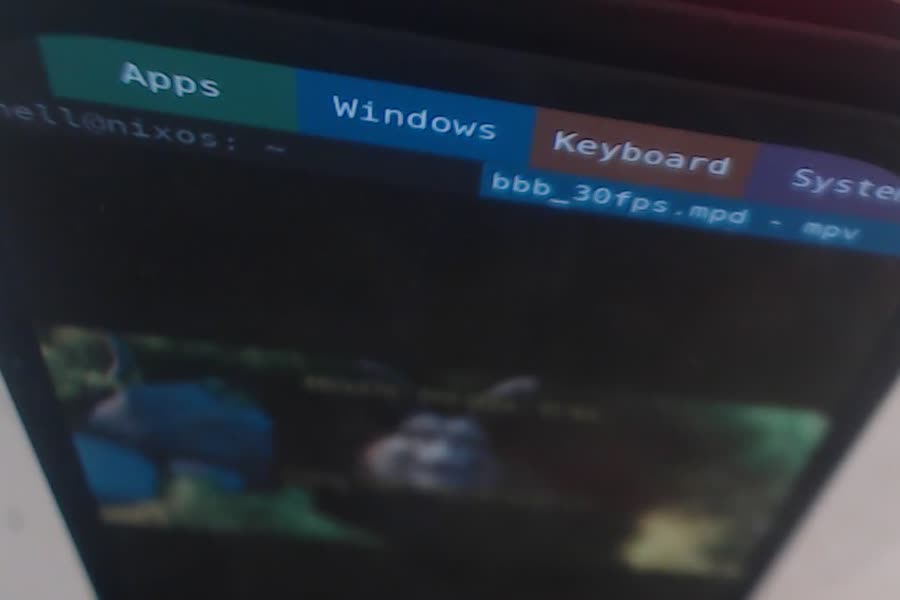
ffmpeg -ss 4 -t 4 -i camera.mp4 -vf crop=900:600:250:130 -c:v libx264 -pix_fmt yuv420p -an
ffmpeg -ss 5 -i camera.mp4 -frames:v 1 -vf crop=900:600:250:130
The camera media is not copied into the repository; the selected derivatives are the privacy-bounded evidence assets.
Limits
The status counters measure mpv’s decoder and video-output counters, not panel scanout or human-perceived smoothness. The native screenshot is a compositor capture, while the camera crop establishes physical display output but is oblique and not a readability calibration. The trial leaves network availability, DASH behavior, and the software-only decode path in the result.