Selected coherent shell survives ordinary reboot
2026-10-01, America/Chicago. Physical board, root coordinator owns serial. The touch-qualified bundle is now installed as the normal boot selection:
python3 tools/coherent-shell-board-boot.py \
  --candidate /nix/store/pnci1pzsca9f45mfyakcrzyk7yx2ad42-k230-coherent-shell-boot-files \
  --state ~/tmp/k230-coherent-boot-board/state.json \
  --qualification docs/evidence/boot-verification/coherent-manual-candidate/operator-navigation.json \
  --output ~/tmp/k230-coherent-boot-board/ordinary --install
Controller/installer source: 0b7fa19f54ec380368ff370190fab43900f96fe9.
Selected shell application source: 5bb67db128210f830dab4de0d20a4b0eca13c578
(as built in the bundle qualification); metadata/installer changes do not
change the running Rust executable.
boot-result.json records the controller SHA256, exact selected system, kernel,
initrd and DTB, all eight original/installed boot-file identities, and actual
installation methods. Only Image, initrd, DTB and bootargs were replaced;
OpenSBI/stage 1 and all three selectors are unchanged. Persistent profile
now selects p1a1hz…, matching the explicit boot init and current system.
The boot partition cannot hold both kernels. Image and initrd required checked root-backed replacement, with an interruption window between removal and rename. The installer journals each phase and retains verified backups and GC roots on root; this is not an atomic whole-bundle installation. Unit tests exercise an interrupted copy and protected-file/qualification refusals, not a physical power-cut experiment.
After the installer returned PASS, the controller issued ordinary reboot.
It did not interrupt autoboot or supply a manual boot command. Linux returned
with the selected kernel, explicit init, current system and persistent profile;
shell, shell-ui and theme-helper were active. serial-observations.txt retains the whitelisted actual Linux version, command
line and identity response from the private serial transcript.
postboot.json independently
records the same identity, the running Rust ELF, all eight installed hashes,
and configured America/Chicago timezone.
The active appearance generation and its report hash match both pre-install and post-install values after reboot. This verifies remembered theme/wallpaper for this existing home, not fresh-image defaults or every upstream theme option.
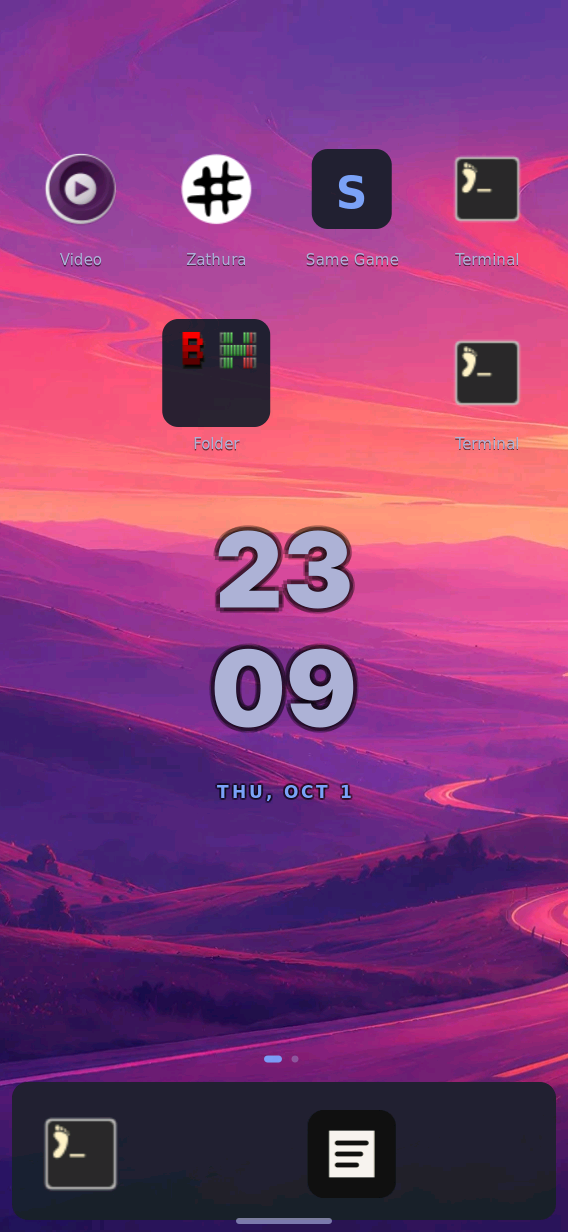
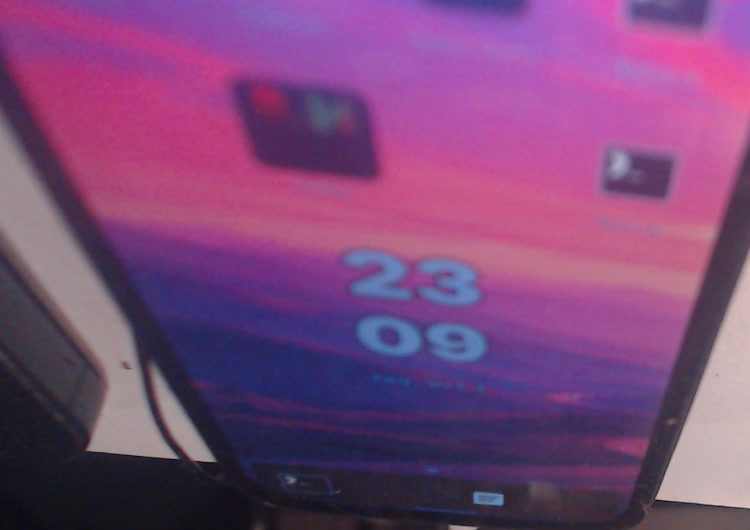
Home was shown with the running Rust client’s --surface hide and the real
compositor’s swaymsg 'card_shell home', then captured with grim. The panel
photograph used:
ffmpeg -nostdin -hide_banner -loglevel error -f v4l2 -input_format mjpeg \
  -video_size 1280x720 -i /dev/video0 \
  -vf 'crop=750:530:530:185,transpose=2,transpose=2' \
  -frames:v 1 -q:v 2 -y ~/tmp/k230-coherent-boot-board/ordinary-home-panel.jpg
Both images were visually reviewed. The panel extends beyond the camera frame;
the native capture shows the full frame. These observations are physical boot,
serial identity, native capture and camera evidence. They do not substitute for
real-finger contact. Prior real-finger qualification is bound to these exact
artifacts in ../coherent-manual-candidate/operator-navigation.json; a subsequent physical power swap returned to the same normal selection.
The fresh identity/hash check and reviewed native/panel observations are in
power-swap recovery.
After the three routes were explicitly requested, the operator replied
“yeah it seems great let’s go”. operator-navigation.json
records that distinct real-finger acceptance, bound to the fresh recovery boot
ID and exact normal artifacts. It does not relabel the earlier injected Home
captures as finger evidence or certify unrelated theme/Home-editing gates.
Recovery retained
Protected board stage:
/var/lib/k230/coherent-boot/p1a1hz9n8s4g8qyr55ffl3dzbnjgqwr8-20261001.
Original eight files live in its backup/, original init/profile closures have
GC roots, and the installer state/result are retained. For a failed boot, stop
at U-Boot on the exclusively reserved serial port, then run the root-backed
baseline controller:
python3 tools/coherent-shell-board-boot.py \
  --candidate /nix/store/pnci1pzsca9f45mfyakcrzyk7yx2ad42-k230-coherent-shell-boot-files \
  --state ~/tmp/k230-coherent-boot-board/state.json \
  --output ~/tmp/k230-coherent-boot-board/recovery --recover-baseline
After the old normal init reaches Linux, restore files/profile using the staged installer (root console), then reboot normally and check identities and Home:
/nix/store/v189xydz6qkcd4cbkixcmv91w8hbc560-python3-riscv64-unknown-linux-gnu-3.14.7/bin/python3 \
  /var/lib/k230/coherent-boot/p1a1hz9n8s4g8qyr55ffl3dzbnjgqwr8-20261001/install.py \
  rollback /var/lib/k230/coherent-boot/p1a1hz9n8s4g8qyr55ffl3dzbnjgqwr8-20261001
reboot
Do not invoke rollback casually: it deliberately reselects the previous system.
The original baseline’s same-path manual boot was physically proved before
installation (../coherent-manual-comparison/). This successful install did not
exercise physical failed-write rollback. Private transport credentials and raw
serial logs remain outside Git under protected ~/tmp files.
CI correction
The source run 36962592218 failed because the installer test fixture assumed
~/tmp existed on a fresh GitHub runner. Commit a9f7a24b creates it before
allocating temporary fixtures. Seven installer, five boot-plan and five strict
UART tests pass locally after that correction; matching CI/Pages run 36963303088 passed build and deployment.
Ordinary-boot proof is published by successful CI/Pages run 36963714103,
exact revision 779de082d55b0089a044442c6873017da9de2bd2.
The preceding proof run 36963641537 rejected an unsupported work-board
status value. Coordinator correction 779de082 uses the schema’s
source-landed value; full work-board generation and the corrected CI pass.
These publication corrections do not alter board artifacts.