Panel recovery after unplugging HDMI, 2026-09-30
Evidence classes: operator-reported disconnect failure; physical-board serial inspection; controlled reboot and userspace reactivation. This record does not prove automatic hotplug switching, visible panel pixels or real-finger input.
Source audit: master 75445cc19801a1d497c87b02af81a4e7db16e42c.
The sole coordinator held the shared board/serial lock throughout.
Observed failure
The operator unplugged HDMI and reported that the monitor went off but the
built-in panel did not come on. The running device-tree model was
LILYGO T-Display-K230 (HDMI), and the only DRM output was HDMI-A-1.
There was no DSI-1 connector for the compositor to enable. The HDMI sysfs
status still read connected; it therefore did not establish live cable state.
Sway PID 45627 had process state Dsl. An explicit two-second Sway IPC query
did not return. Its kernel stack was:
modeset_lock+0xe2/0x150
drm_modeset_lock_all_ctx+0x2e/0x14c
drm_mode_obj_get_properties_ioctl+0xb6/0x1a4
drm_ioctl_kernel+0xb8/0x13e
drm_ioctl+0x21a/0x434
__riscv_sys_ioctl+0xb6/0xc4
do_trap_ecall_u+0x132/0x144
_save_context+0xba/0xba
This establishes a blocked kernel DRM ioctl after the reported unplug. It does not identify the lock owner or prove which disconnect path caused the blockage. No live connector teardown/rebind was attempted.
Recovery performed
Preflight confirmed the normal boot DTB still named LILYGO T-Display-K230
without the HDMI suffix. Its SHA256 was
ffeb528bba1b4c3ab5e6b6f63047cd9ae9512ed853126616853367e93dba2035.
Boot selectors still pointed at k230-tdisplay.dtb. No DTB, kernel, initrd or
boot selector was replaced. A fresh host-only nix build .#deviceTree --no-link --print-out-paths also succeeded; that new DTB was not deployed.
The existing panel boot arguments pointed at the older x1xbs5qd… system,
while the live userspace had been test-activated to the newer r0knnb72… system.
The board was synchronized, then rebooted with
systemctl reboot --force --force to avoid waiting on the blocked compositor.
The normal boot used the panel DTB. Its log showed the universal DSI device
attached, both canaan DRM components bound, and the framebuffer initialized.
Serial inspection then showed DSI-1 connected and the old shell services
active. The latest already-installed userspace was reactivated using:
systemd-run --unit=k230-panel-shell-restore --no-block /nix/store/r0knnb72k3p3mpmbsnfgrk66yg8gl144-nixos-system-nixos-26.11.20260919.20b1ddd/bin/switch-to-configuration switch
The activation exited with Result=success, ExecMainStatus=0. The current
system and system profile resolved to r0knnb72…. The shell, shell UI and
trackpad relay were active; Sway was sleeping normally rather than blocked.
Sway IPC returned DSI-1, 568×1232, transform normal, active/power/DPMS true,
scale 1, and max_render_time=8. DRM state showed the Sway-owned RGB565
framebuffer on the panel CRTC, and backlight brightness was 254.
These are connector/scanout observations, not an optical image acceptance.
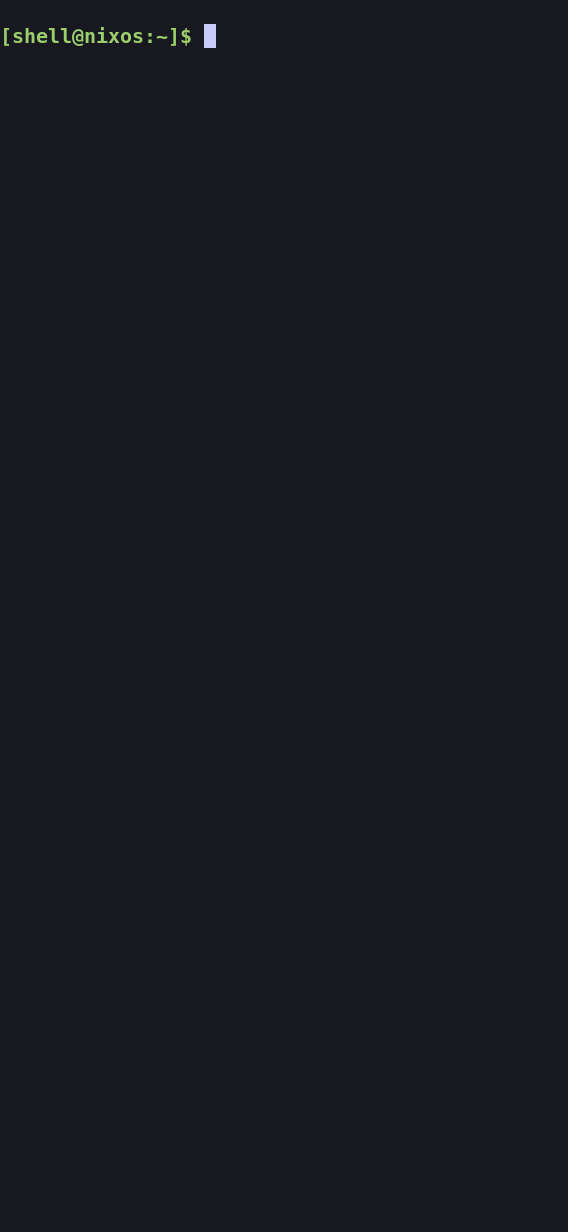
A subsequently collected and visually reviewed native capture shows Foot on the panel output. Capture identity preserves the exact command, timestamp, executables and SHA256. The serial base64 transfer was framed and decoded into the original JPEG bytes; it was not cropped or reconstructed. The native capture does not establish physical panel emission.
Remaining gates and limits
- UNVERIFIED: visible recovered panel pixels and real-finger navigation; the coordinator requested an operator observation. The camera view did not supply usable visible-screen evidence and was not published.
- Unimplemented: automatic HDMI-to-panel switching without reboot. The installed kernel boot selects one downstream DSI device. Switching requires the separate live-driver/connector work in the HDMI proposal, not merely a Sway output stanza.
- Open defect: unplugging left Sway blocked in
modeset_lock. Capture the lock owner and bridge/DRM worker stacks in a reserved, recoverable reproduction before choosing a kernel fix. - Not reconciled by this recovery: the boot arguments still select the older panel system. The latest userspace was reactivated after boot. This record does not claim a fresh reboot persistently selects the latest shell.
- The HDMI Settings switch and one-shot restoration UI remain incomplete. No HDMI proposal task was checked or archived based on this recovery.
This recovery is separate from the six proposal-closeout acceptance gates. It does not certify a patch-free kernel or any physical UX/performance budget.