Sustained app-drawer scroll on the installed board: about 10 frames per second
Evidence class: board, injected native touch. A persistent uinput touchscreen sent one report every 8.14 ms, the measured real-finger rate (touch-rate). There was no real-glass interaction and no camera recording for this measurement.
The runs took place on 2026-10-22 between 03:23Z and 03:37Z. The system was
/nix/store/8xkkpma4fvgw4fi6pl8qaz7d9d75kcdi-nixos-system-nixos-26.11.20260919.20b1ddd,
the persistent profile installed by
the 12 ms allowance change.
Output DSI-1 was in landscape (1232x568, transform 270) with
max_render_time 12. One CPU was online, and 19 apps were in the drawer.
Result
The drawer misses its ~20 ms target, and also exceeds the top of the design’s 17.3–34.6 ms estimate (app-drawer review §3.4).
| Run | K230_DRAWER_FRAME ms= during contact, median / p95 / max | Samples | Presented frames per second during contact | Frame interval within one drag, median / p95 |
|---|---|---|---|---|
| run2 | 38.86 / 53.35 / 57.65 ms | 72 | 8.31 | 97.4 / 118.4 ms |
| run3 | 39.49 / 53.37 / 75.78 ms | 72 | 8.35 | 95.3 / 110.0 ms |
| run4 | 39.06 / 52.88 / 54.73 ms | 72 | 8.35 | 97.2 / 111.4 ms |
| run6 (traced, 30 s) | 39.56 / 52.64 / 55.25 ms | 36 | 8.35 | 100.7 / 124.7 ms |
Every one of the 252 contact samples is over 34.6 ms.
- The
ms=value is the wall time ofRendererCache::draw(render cost), rate-limited to one sample every 500 ms. On this single-CPU board it includes any time the client is pre-empted. - The presented-frame columns come from the client’s own
frame-donelog lines, which are the compositor’s frame callbacks. - In every run, every injected touch step was delivered as a
touch-move(3,408 per 60 s run). - The frame that opens the drawer takes 9.6–10.5 ms, so the cost appears only once scrolling starts.
CPU over the 60.6 s of run4, of which 31.4 s was contact (fractions of the
one core): shell-ui 0.291, sway 0.098, systemd-journald 0.031, injector
0.016. Whole-system busy time was 0.481. Almost all of that load falls inside
the contact windows, so the core is close to saturated while the finger is
down.
Where the time goes (traced run6)
The installed client’s opt-in recorder (runtime_trace.rs, thread-CPU and
wall time per span) was enabled with a volatile drop-in for one 45 s window.
Over the 15.7 s of contact, with no dropped events
(trace-analysis.json):
- All 154 drawer frames rendered during contact did a full
scene_rebuild(median 33.8 ms thread CPU, 49.4 ms wall). The cause is inRendererCache::draw_with_hud(nix/rust-shell-client/src/render.rs): any scroll change of 0.25 px or more takes the rebuild path. That path allocates a new full-screen buffer and repaints the whole drawer sheet: clear, background brush, grid slice fromDrawerGridCache, and chrome. The grid cache does what the design intended, but the scene around it is rebuilt on every scroll frame. - The client’s main thread used 55.6% of contact time in total: 56.6 ms of
CPU per rendered frame. Of that, 32.8 ms was
render_total. The remaining ~23.5 ms per frame was Wayland dispatch outside rendering, which covers delivering about 110 touch events per second. The recorder does not attribute this further. The client writes onetouch-movejournal line per event (main.rs); that is a candidate cost, not a measured one.
Workload and commands
drawer-scroll.py is run as root under the exclusive board lock:
flock -n /tmp/k230-board.lock "$PY" drawer-scroll.py RUN_DIR "$SYSTEM" 60
$PY is the system closure’s python3. The script:
- Checks the installed system and the landscape output.
- Opens the drawer with
k230-shell-rust --surface drawer. - Repeats four drags at x=616 for the given duration, with 600 ms between
them:
- a 250 ms flick from y=470 to y=130;
- the same flick back;
- a 900 ms drag from y=450 to y=150, held for 150 ms;
- the same slow drag back.
- Closes the drawer with
--surface hide. - Saves gesture windows, cgroup CPU counters (from run3 on), grim captures,
and the
shell-uijournal.
analyze.py replays each run:
python3 analyze.py.txt runN
traced-run.py wraps a 30 s workload. It writes
/run/systemd/system/shell-ui.service.d/90-drawer-jank-trace.conf
(K230_TRACE_PATH, K230_TRACE_SECONDS=45) and restarts shell-ui once. It
then removes the drop-in and restarts shell-ui normally. The sway PID was
unchanged (1049) throughout. trace-analyze.py replays
the trace:
python3 trace-analyze.py.txt run6 run6/trace.json
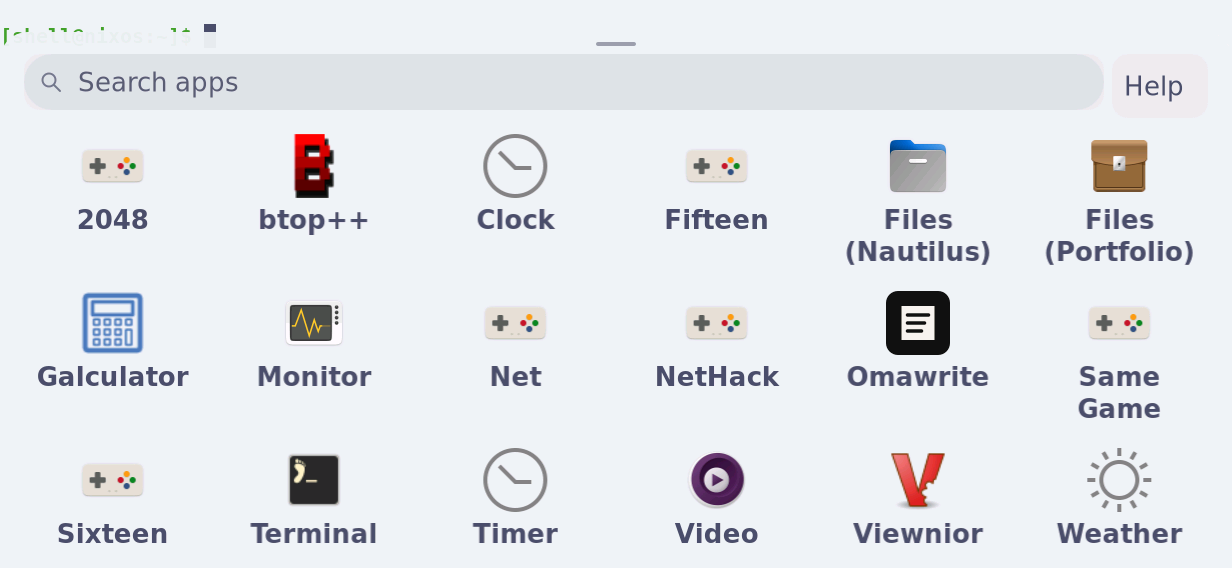
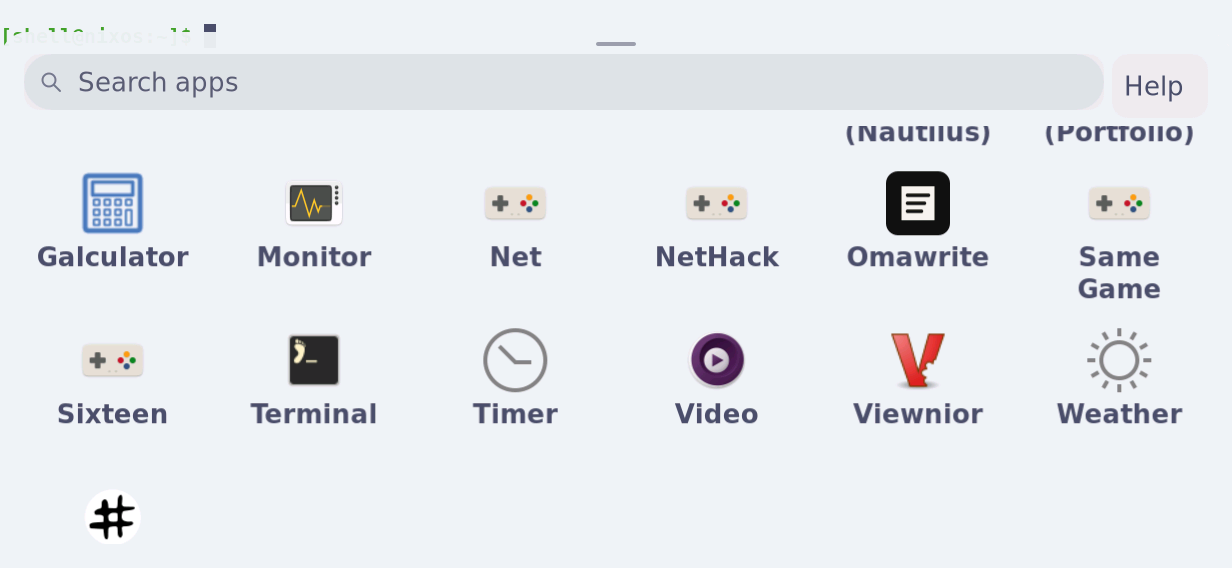
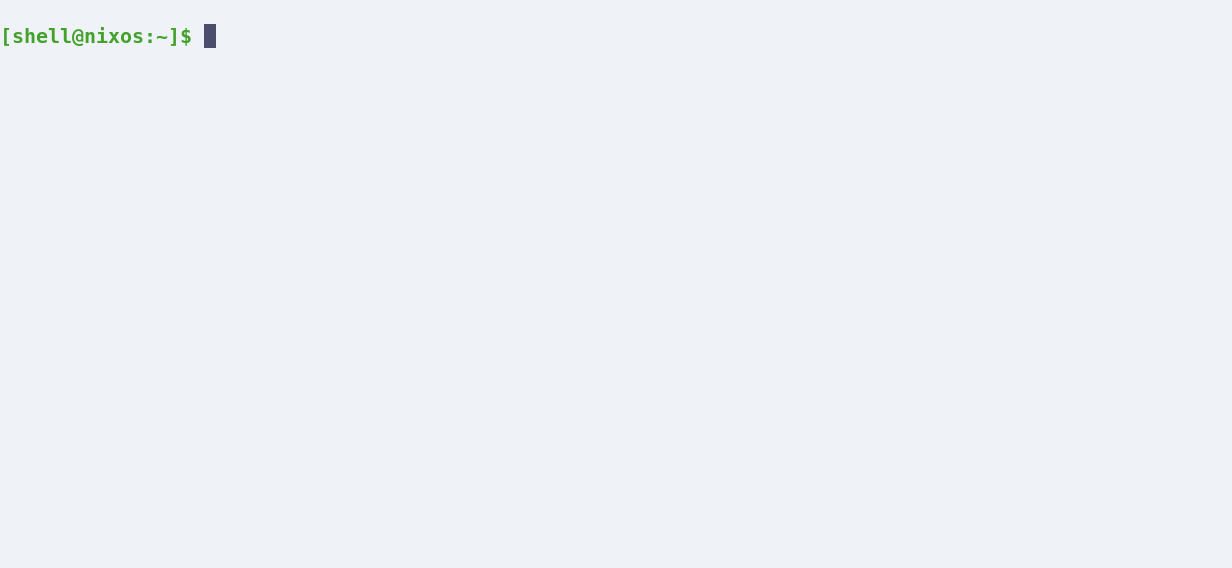
Captures from run4 show the drawer open (drawer-open.png), scrolled (mid-scroll.png) and closed afterwards (after-close.png).
Discarded and failed attempts
- run1 (discarded): the first injector busy-waited between 8.14 ms steps. On a one-CPU board that steals time from the client being measured, and render samples read 73–123 ms. The data is kept in run1 and must not be used. The script now sleeps between steps.
- run5 (failed, no data): the trace directory under
/var/lib/k230was not traversable for theshelluser, and the client loggedtrace unavailable: Permission denied. The wrapper still removed its drop-in and restartedshell-uinormally (manifest). run6 put the trace under/var/tmp.
Owned board files (/var/lib/k230/drawer-jank, /var/tmp/drawer-jank-*)
were removed afterwards. Both services were active, and no shell-ui drop-in
remained.
Limits
- Injected touch skips the Goodix interrupt and driver path; a real finger adds that cost.
- The
ms=probe is render wall time only. Presentation latency (motion-to-photon) was not measured. - Only landscape was measured; portrait was not.
- The drawer held 19 apps, and no search query was active.