Keyboard frames and the OVER blend of opaque surfaces
Evidence class: board, injected native touch. All captures were taken on
2026-10-25 (UTC) on the board’s DSI panel in landscape: 1232x568 logical
pixels, 52.19 Hz (19.16 ms per refresh), max_render_time 12, one online
CPU. There was no real glass and no camera.
Workload
measure.sh from compositor-repaint,
unchanged: a 30 s drawer scroll, then eight
keyboard cycles (show, type,
hold-and-reverse, hide) with the compositor benchmark armed. The analysers are
analyze.py for the keyboard and
cadence.py for the drawer.
| Run | System | Pixman in sway | Time (UTC) |
|---|---|---|---|
| run-base | pb5l6lmb (boot default), test-activated | stock RVV | 00:53 |
| run-first | jpc0hl8p, test-activated | first patch: test every chunk | 00:51 |
| run-final | h4rqzlgr, test-activated | final patch: per-row bail-out | 00:59 |
| run-boot | h4rqzlgr, boot default, ordinary boot | final patch | 01:07 |
All three ran on the same boot within nine minutes, in the order first, base, final.
Where the settle time went
Show settle was the last keyboard phase over budget after compositor-repaint (38.3 ms presented interval, 16 ms render).
-
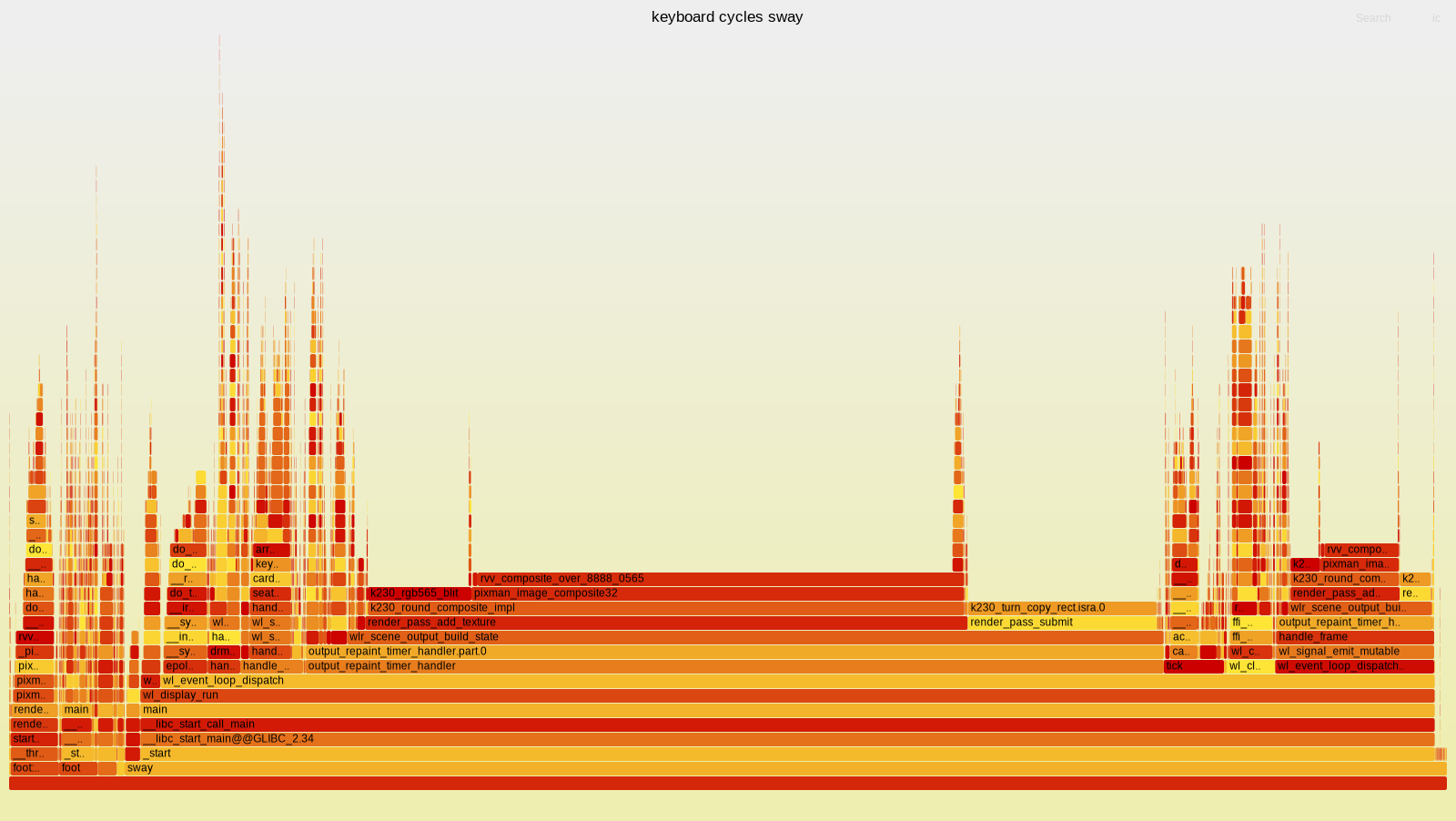
Profiles timed on CLOCK_MONOTONIC. prof-base records sway with
perf record -k CLOCK_MONOTONIC(otherwisetools/board-profile.py, unchanged), so samples line up with the benchmark’s repaint rows. Without-k, perf’s clock ran 2.31 s from CLOCK_MONOTONIC on this boot.perframe.pygives the CPU per frame for each phase (per-frame.txt). In full-damage settle frames,rvv_composite_over_8888_0565took 6.1 ms per frame, against 1.3 ms in full-damage show-contact frames. -
No preemption. A system-wide
sched:sched_switchtrace of the same workload (schedwin.py, result) shows sway on the CPU for its whole repaint in every phase. The raw trace is not committed. -
What is composited. A logging
LD_PRELOADshim (composite-shim.c) recorded everypixman_image_composite32call in sway for three cycles (composites, replay withcomposites.py). Each keyboard frame blends three ARGB8888 surfaces OVER the RGB565 output:- the Foot window, 1232x568;
- wvkbd’s key-preview popup, 1232x480, which is fully transparent unless a key is held;
- the keyboard, 1232x240.
wvkbd’s colours carry no alpha, so the keyboard is opaque. The Foot terminal is opaque too. OVER still reads and blends the destination for every pixel of all three.
-
Not the popup alone. wvkbd creates the popup surface even with
--no-popup, so the popup A/B (wvkbd restarted with--no-popupunder a transient unit) changed nothing: show-settle render 16.1 → 16.7 ms. The normal keyboard service was restarted afterwards.
The change
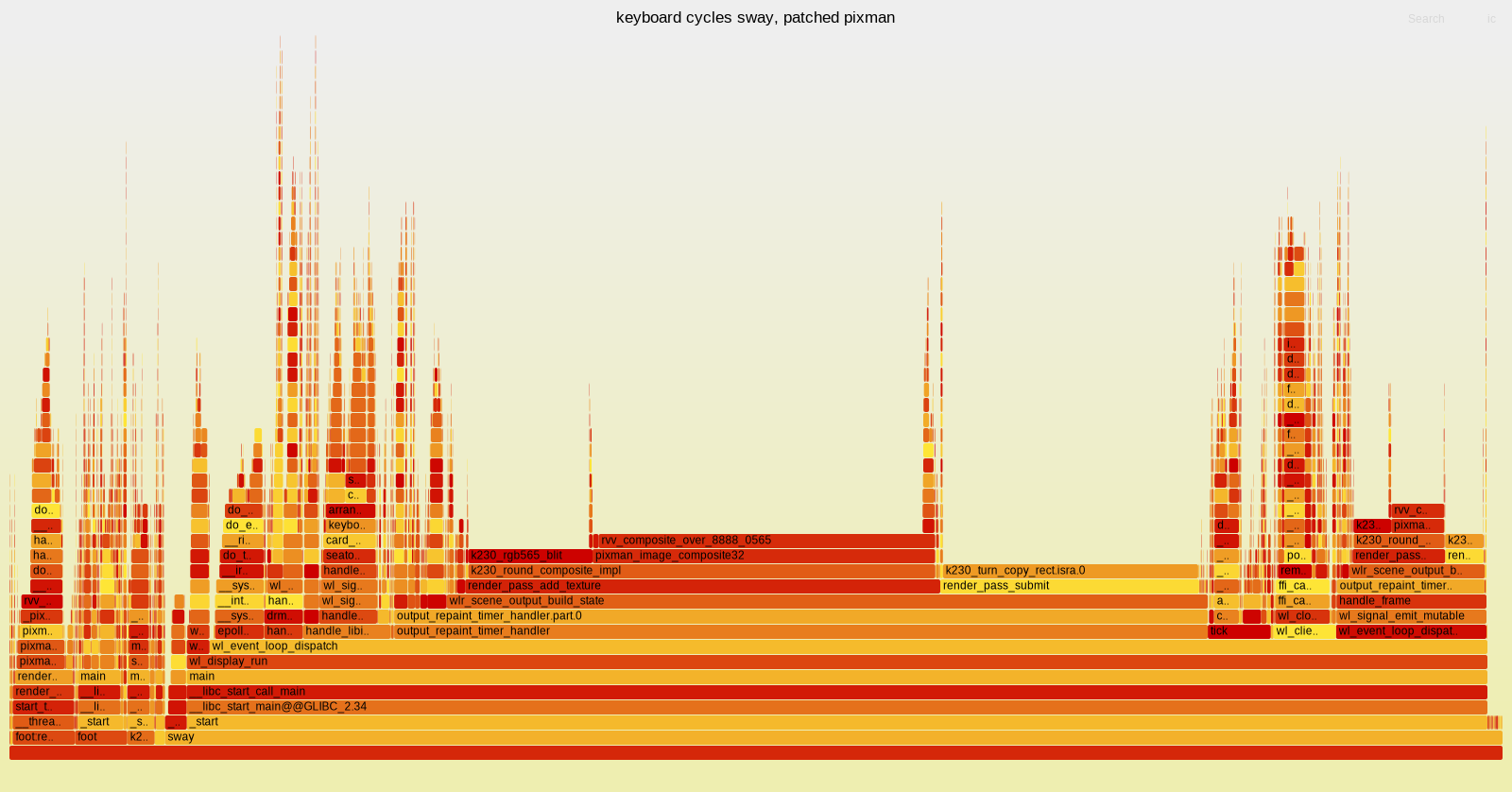
nix/patches/pixman-rvv-over-0565-exact-shortcuts.patch adds two exact
shortcuts to Pixman’s RVV over_8888_0565 (OVER, a8r8g8b8 → r5g6b5):
- a vector chunk whose source alpha is all 0xff is converted and stored. OVER with alpha 0xff yields the source;
- a chunk whose source is all zero is skipped. OVER leaves the destination unchanged, and the 0565 → 0888 → 0565 round trip is lossless.
Neither declares or infers an opaque region, and nothing below a surface is culled. Each frame is the same OVER blend as before, computed faster.
The first version tested every chunk. On the drawer, whose sheet is drawn at alpha 0.95, every chunk failed both tests: sway’s drawer repaint rose from 10.19 to 10.79 ms (run-first). The final version stops testing for the rest of a row once a chunk is neither, so a uniformly translucent surface pays one test per row.
Only the compositor gets the patch. nix/card-shell.nix builds sway’s
wlroots against the patched Pixman and puts it first in sway’s build inputs,
so sway’s RUNPATH resolves its own libpixman-1.so.0 there. Cairo’s request
then reuses it by soname. On the board, /proc/<sway>/maps shows only
sn5is273…-pixman on h4rqzlgr. The rest of the closure keeps the shared
Pixman: patching it globally would rebuild 104 store paths (about 300 MB,
GTK, GStreamer, Nautilus among them), whereas the system delta for this
change is about 25 MB.
Exactness
exact.c, built by exact.nix, composites
112 OVER a8r8g8b8 → r5g6b5 cases on the board:
- 16 widths (1 to 1232), with odd source and destination offsets and strides;
- seven source patterns: all opaque, all zero, random alpha, 11-pixel runs, alpha 0 with non-zero colour, alpha 1 or 254, and sparse mixes.
It ran under stock RVV Pixman (brhzfimak…), patched RVV Pixman
(sn5is273…), and the patched library with PIXMAN_DISABLE=rvv. All three
destination dumps have sha256 a39338ae…be41.
The same program timed a keyboard-sized 1232x240 composite (best of 30, heap memory):
| Source | Stock RVV | Patched RVV | Scalar |
|---|---|---|---|
| Opaque | 2.28 ms | 1.01 ms | 2.42 ms |
| Alpha 242 everywhere | 2.37 ms | 2.26 ms | 9.92 ms |
| Random alpha | 2.28 ms | 2.26 ms | 9.77 ms |
Each run’s grim captures were taken from sway’s output:
- keyboard: before, shown, hidden;
- drawer: open, mid-scroll, after close.
All six are pixel-identical between run-base and run-final, with an empty difference bounding box. They are not committed, matching compositor-repaint.
Results
Cells give the presented interval median / p95 in ms, intervals over 33.334 ms, and the render wall median / p95 in ms.
| Phase | run-base | run-final |
|---|---|---|
| Show, contact | 19.2 / 172.5, 29 of 78, 8.4 / 20.3 | 19.2 / 172.4, 21 of 94, 8.1 / 16.0 |
| Show, settle | 38.3 / 57.5, 79 of 102, 16.0 / 17.5 | 19.2 / 57.5, 54 of 124, 10.0 / 12.9 |
| Hold and reverse, contact | 19.2 / 57.5, 28 of 304, 9.8 / 11.6 | 19.2 / 57.5, 22 of 305, 7.0 / 8.3 |
| Hold and reverse, settle | 57.5 / 115.0, 19 of 33, 10.7 / 18.7 | 19.2 / 76.6, 9 of 19, 8.4 / 14.0 |
| Hide, contact | 19.2 / 19.2, 2 of 129, 8.7 / 11.4 | 19.2 / 19.2, 0 of 134, 6.2 / 8.1 |
| Drawer | run-base | run-first | run-final |
|---|---|---|---|
| Distinct presented fps | 23.6 | 23.3 | 24.2 |
| Interval median / p95 | 21 / 39 ms | 21 / 39 ms | 21 / 39 ms |
| Sway repaint median (p10–p90) | 10.19 (10.08–10.31) ms | 10.79 (10.69–10.90) ms | 10.22 (10.11–10.33) ms |
- Show settle now presents a median of every refresh. Its p95 is still three refreshes and 54 intervals remain over budget, so it is not declared passed.
- Every keyboard render is about 2.5 ms shorter at the median.
- The drawer is unchanged against run-base.
- All frames were presented in every run (889, 916 and 922 rows).
preload-trial ran the first patch under a runtime-only
LD_LIBRARY_PATH drop-in in /run/systemd/system/shell.service.d/ before
any system was built (show-settle render 16.6 → 12.2 ms). It was removed
again, and /proc/<sway>/maps showed the stock Pixman afterwards.
prof-trial profiles that arm.
slowfast.py splits its settle frames into those under
and over 11 ms (slow-fast.txt).
Promotion to the boot default
On 2026-10-25, h4rqzlgr (commit 44997ea3, which is what master evaluates
to) replaced pb5l6lmb as the persistent system. The kernel and initrd are
identical between the two. promote.py is the
card-resize promotion script with the system paths, state directory and
source revision changed. It ran as root under the board lock and set the
profile to system-89-link.
An SSH-initiated reboot booted h4rqzlgr as both /run/booted-system and
/run/current-system, with shell, shell-ui and shell-keyboard active,
no failed units, sway at SCHED_RR and sn5is273…-pixman mapped in sway.
See the receipt, boot ID b10247c0….
run-boot repeated the measurement on that boot:
- keyboard renders match run-final: hold-reverse contact 6.9 ms, hide contact 6.2 ms, show settle 12.0 ms (p95 12.8 ms);
- show settle’s presented interval median was 38.3 ms (66 of 111 intervals over budget), against 19.2 ms in run-final. Its render median sits at the 12 ms allowance, so this phase is at the edge and is not declared passed;
- drawer: 23.4 distinct fps, sway repaint median 10.13 ms.
Rollback: write the copies under
/var/lib/k230/keyboard-blend-promote-20261025/promotion/rollback/ back to
/boot, then run nix-env --profile /nix/var/nix/profiles/system --set with
pb5l6lmb.
Limits
- Injected touch skips the Goodix interrupt and driver path.
- Presentation time is not photon time.
- Only landscape was measured, with one Foot window as the app.
- One run per build. Card entry and the shade were not re-run; they composite through other paths (scaled cards, the shade’s sheet) and are not claimed either way.
- Profiles sample at 499 Hz with 64 KiB DWARF stacks (
perf record -q, so lost-sample counts were not reported). Sampled CPU per frame is below the repaint wall time, so the profiles give shares, and timing comes from the unprofiled runs.
Owned files under /var/tmp were removed.