On-screen keyboard show, type, hold/reverse and hide on the installed board: budget missed
Evidence class: board, injected native touch. A persistent uinput
touchscreen sent one report every 8.14 ms, the measured real-finger rate.
There was no real-glass interaction and no camera recording. The board ran
system
/nix/store/8xkkpma4fvgw4fi6pl8qaz7d9d75kcdi-nixos-system-nixos-26.11.20260919.20b1ddd
on 2026-10-22, with DSI-1 in landscape (1232x568, transform 270) and
max_render_time 12. One CPU was online. The installed keyboard is 240 px
tall (SWAY_K230_KEYBOARD_HEIGHT=240), with a 56 px grip band above it.
The instrumentation is the installed compositor’s own benchmark. While
armed (swaymsg card_shell benchmark injected … benchmark-stop), sway logs
the following for every output frame:
event=present(presentation time, CLOCK_MONOTONIC);repaint-timing(render start/commit/end wall time);frame-damage(damaged pixels).
Its per-input latency rows cover card gestures only (card_shell_motion
records an input only when the card shell is active). They are therefore
absent here, and this report does not claim input-to-present latency for
keyboard motion.
Workload
keyboard-cycles.py first opens an owned Foot window
(k230.kbd.trial, running cat >/dev/null, so typed keys go nowhere). It
then repeats eight cycles:
- Show: two contacts in the bottom 72 px, 40 ms and 200 px apart, swiped up 250 px over 400 ms, followed by an 800 ms settle.
- Type: three key taps, then a 400 ms pause.
- Hold and reverse: a grip drag 150 px down over 400 ms, held still for 300 ms, then dragged back up over 300 ms, followed by an 800 ms settle.
- Hide: a grip drag 260 px down over 350 ms, followed by a 1 s settle.
Afterwards the script closes the window and saves the shell and
shell-keyboard journals. The command, run as root under the exclusive
board lock, was:
flock -n /tmp/k230-board.lock "$PY" keyboard-cycles.py RUN_DIR "$SYSTEM" 8 --bench
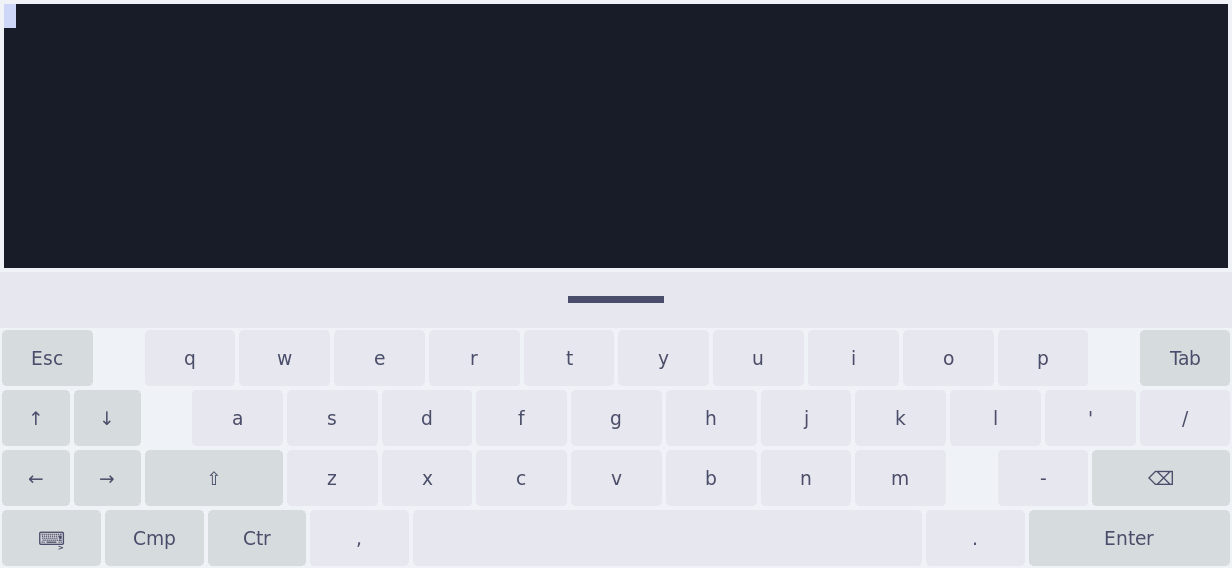
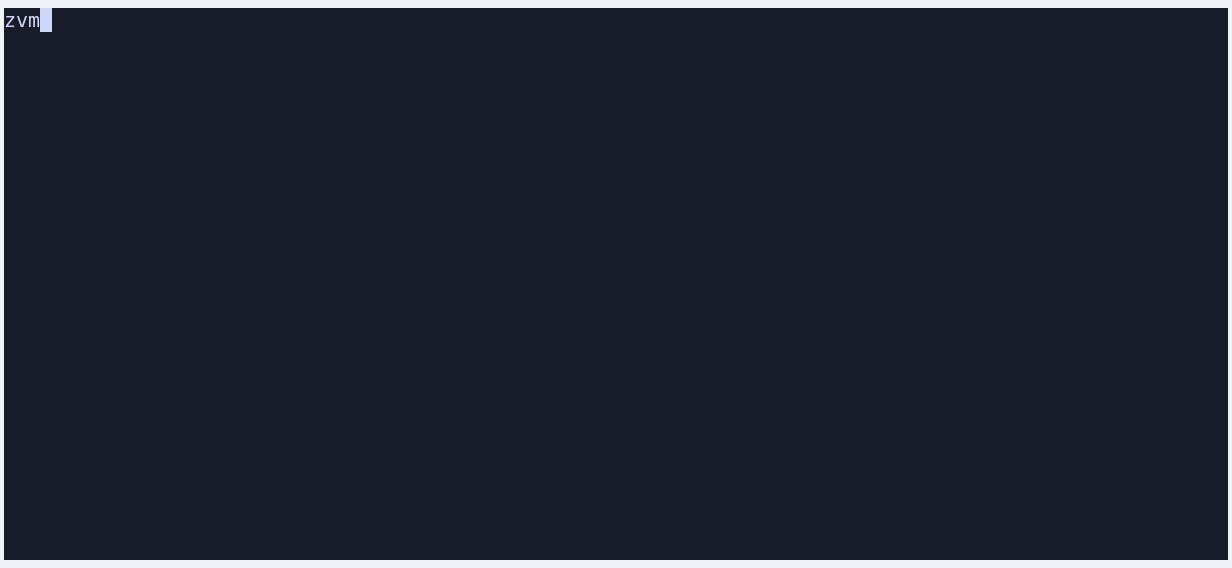
The functional probe (probe1, one cycle, no benchmark) captured:
- the shown keyboard (shown.png);
- the typed
zvmin the trial window once the keyboard was hidden (hidden.png).
Replay either run with:
python3 analyze.py.txt bench1
analyze.py splits frames into windows by gesture. A window runs from one gesture’s first contact to the next gesture’s first contact. Within it, “contact” means a finger was down and “settle” covers the motion after release.
Results
bench1 ran 03:45:03–03:45:57Z and bench2 ran 03:46:52–03:47:46Z. Every frame was presented (592 and 588 rows), and the trial window was closed after each run.
| Phase (bench1 / bench2) | Presented interval median | p95 | Intervals over 33.334 ms | Render wall median / p95 |
|---|---|---|---|---|
| Show, contact | 76.7 / 76.6 ms | 172.5 / 172.4 ms | 22/22, 24/24 | 35.3 / 51.4, 33.3 / 51.2 ms |
| Show, settle | 57.5 / 57.5 ms | 76.7 / 95.8 ms | 63/66, 68/71 | 41.8 / 55.3, 38.7 / 52.9 ms |
| Hold and reverse, contact | 38.3 / 38.3 ms | 57.5 / 57.5 ms | 162/171, 159/165 | 23.0 / 29.8, 23.4 / 30.8 ms |
| Hold and reverse, settle | 38.3 / 38.3 ms | 57.5 / 57.5 ms | 32/35, 35/36 | 24.6 / 33.0, 24.4 / 41.5 ms |
| Hide, contact | 38.3 / 38.3 ms | 38.3 / 38.3 ms | 63/63, 63/63 | 21.1 / 28.8, 21.6 / 27.9 ms |
Every moving phase misses the card frame budget (presented interval p95 33.334 ms or less, the frozen budget in card-shell frame budget).
- During a grip drag the keyboard updates every second panel refresh (38.3 ms, about 26 frames per second).
- During the show swipe it updates about every fourth refresh (76.7 ms, about 13 frames per second).
- Render wall time is 21–42 ms against the 12 ms allowance, so frames miss their refresh.
Show and hide durations:
- Show: the first presented frame arrives a median 79.0 / 78.9 ms after first contact, and the last frame of the show motion arrives at 999 / 964 ms.
- Hide: the last frame arrives at 797 / 780 ms after first contact.
The typing rows are not a tracking measure: the window includes idle time between taps. Typing renders were short (median 2.3 ms), and key-tap acknowledgement was not timed separately.
What the frames cost
- Damage: the show motion repaints the whole output on every frame (median damaged fraction 1.00). Grip drags and hide repaint a median 52%, which is the keyboard plus the app area above it.
- Rearranging: the compositor rearranges the workspace on every
keyboard frame. Sway’s debug log shows about 1,480
Usable area changed, rearranging output/Arranging workspacepairs per 54 s run. This is the per-tick usable-area update fromthe-keyboard-follows-touch-gesturestask 2.4, and it makes the focused app reconfigure while the keyboard moves. - Debug logging: the installed configuration runs sway with
-d(k230.shell.debugLog = trueinflake.nix). The flake’s own comment calls this a bring-up setting that “should leave with” its change. About 4,800 DEBUG journal lines are written per run (about 90 per second), all on the one CPU. An earlier same-binary comparison measured journald at about 0.10 cores for benchmark-volume logging (log destination). Its effect on keyboard frames was not isolated here.
The benchmark’s own rows also go to the journal (about three per frame), so these runs carry that observer cost.
Limits
- Injected touch skips the Goodix interrupt and driver path.
- There is no per-input latency for keyboard motion; presented intervals and render wall time are what is measured.
- No camera recording or real glass was used.
- Only landscape was measured. One owned Foot window was the app being resized.
- This records a measured miss. Nothing was optimized, and no budget is waived.
Owned board files (/var/lib/k230/kbd-jank) were removed. The trial window
closed itself in every run.