Notification-shade pulls after the compositor change
Evidence class: board, injected native touch. All captures were taken on
2026-10-22 on the board’s DSI panel in landscape: 1232x568 logical pixels,
52.19 Hz (19.16 ms per refresh), max_render_time 12 unless noted, one
online CPU. There was no real glass and no camera.
Workload
shade-pull.py is derived from the drawer workload. It
drives a persistent uinput touchscreen at the measured real-finger report rate
(8.14 ms). Each of 10 pulls:
- starts one contact in the top edge band, at y 4;
- drags it down 400 px over 400 ms and releases;
- leaves the shade open for 1.5 s;
- hides it with
k230-shell-rust --surface hide, then pauses 1 s.
run.sh runs the workload and then
cadence.py, which reports frames
presented during contact. For n3 and later it also armed the compositor
benchmark. gaps.py reports presented-frame gaps from the
start of each pull until 600 ms after release; its output is in
gaps.txt.
| Run | Build | Notes |
|---|---|---|
| base | g2yjvzv4 | boot default after the compositor change |
| n, n2, n3 | sgjam1h0 | k230-settings status without pgrep, test-activated; n3 with the compositor benchmark |
| n-mrt15, n-mrtoff | sgjam1h0 | max_render_time 15 / off at runtime, restored to 12 afterwards |
| boot | sgjam1h0 | boot default, ordinary boot after promotion; compositor benchmark armed |
The pgrep cost
prof-base profiled the shell’s processes and
their children during the 10 pulls on g2yjvzv4. pgrep used 789 ms of
sampled CPU, about 79 ms per pull. The native status helper, k230-settings
and k230-settings-s, used 282 ms between them.
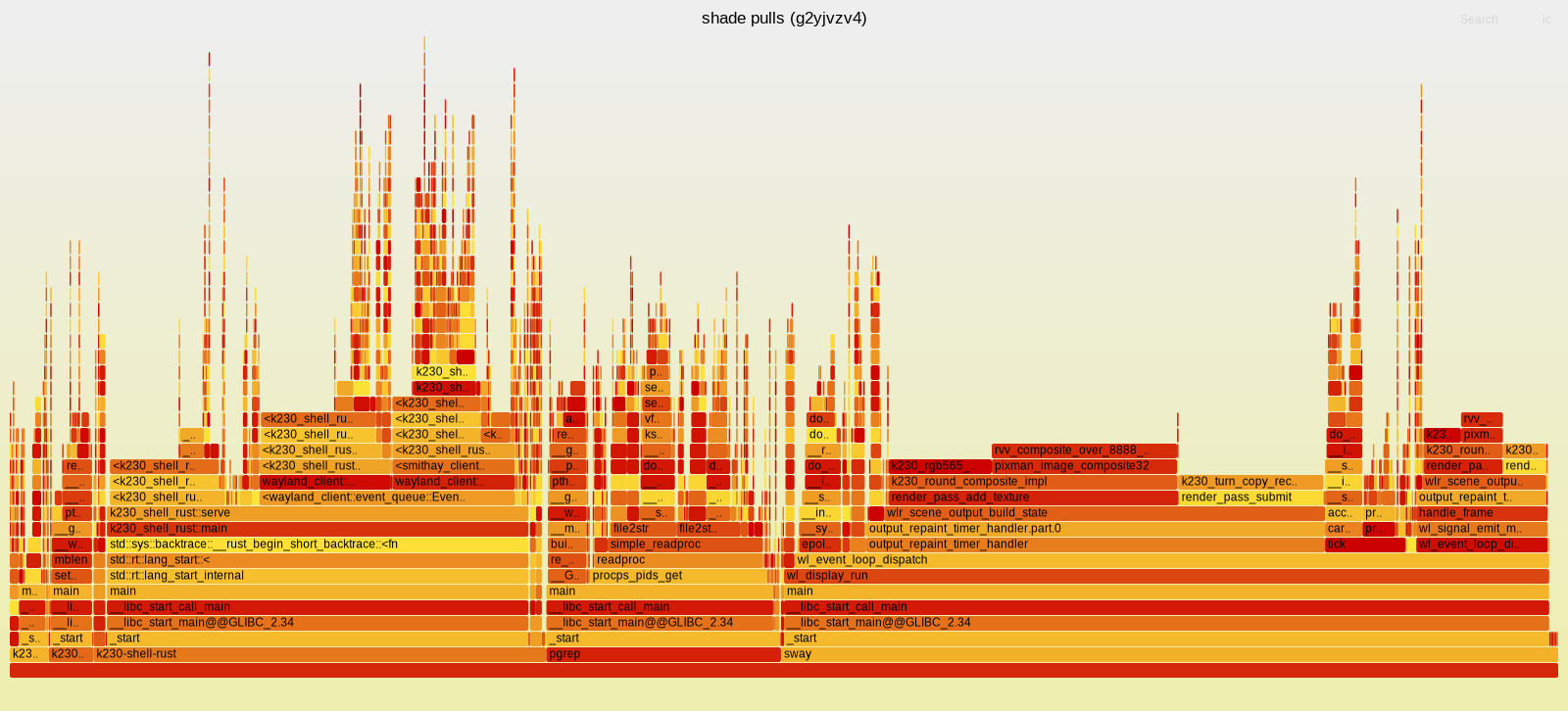
The helper (nix/settings-status.c) ran pgrep -u UID -x wvkbd-mobintl to
decide whether to offer the keyboard toggle. procps reads every /proc entry
in full, and its stacks show glibc loading gconv modules to compile its
regular expression.
The replacement reads each /proc/PID/comm. Only for a name match does it
read status, to compare the effective UID. Host tests check it against a
fake /proc (tests/test_settings_status.py).
On the board, as the shell user, five consecutive k230-settings status
calls averaged:
- old wrapper (
kdc5bmnq…-k230-settings): 103 ms per call; - new wrapper (
q50zzfy1…-k230-settings): 28 ms per call.
Both reported the keyboard as action, with wvkbd running.
Results
| Run | Distinct fps in contact | Interval median / p95 | Client callback → commit median | Pull + 600 ms: median / p90 / max gap | Sway repaint median |
|---|---|---|---|---|---|
| base | 33.4 | 22 / 32 ms | 21 ms | 23 / 38 / 53 ms | not armed |
| n | 33.6 | 24 / 38 ms | 6 ms | 33 / 38 / 50 ms | not armed |
| n2 | 33.2 | 33 / 38 ms | 5 ms | 34 / 38 / 53 ms | not armed |
| n3 | 34.8 | 20 / 37 ms | 7 ms | 22 / 36 / 39 ms | 13.1 ms, 699,776 px every frame |
| n-mrt15 | 34.8 | 20 / 38 ms | 20 ms | — | 13.0 ms |
| n-mrtoff | 34.3 | 22 / 33 ms | 18 ms | — | 13.0 ms |
| boot | 34.0 | 20 / 37 ms | 8 ms | 29 / 37 / 58 ms | 13.0 ms, 699,776 px on 155 of 158 frames |
- What removing
pgrepchanged. The client now commits within 5–7 ms of its frame callback, down from 21 ms. Each status read costs about 75 ms less CPU. - What it did not change: presented cadence. Before and after, presented frames run at about 34 fps, with gaps of at most 38–53 ms (two refreshes, occasionally three).
- Why. The shade moves the whole screen every frame, so sway’s full-screen repaint (13.1 ms) plus the client’s draw (about 6 ms) is about one 19.16 ms refresh of CPU on the one core.
max_render_timeis not the limit. Setting it to 15 or off made sway repaint more often, without more distinct presented frames.- The original stutter report. That report recorded 77 ms median gaps.
The base run, on the compositor change already promoted
(
docs/evidence/interaction-jank/compositor-repaint/), shows that most of that stutter was already gone before this change. - What would make the shade faster.
- Sway’s remaining cost is blending the translucent shade over the layers beneath, plus the quarter-turn.
- An opaque region on a sliding surface is excluded by the operator’s 2026-10-22 decision, so the next step would need a cheaper full-screen composite or a change in what the shade redraws.
Promotion to the boot default
On 2026-10-22, sgjam1h0 (built from commit 31fbcb61; master at e7673f86
evaluates to the same path) replaced g2yjvzv4 as the persistent system.
promote.py is the compositor promotion script
with the two system paths and the state directory changed. It ran as root
under the board lock, swapped the one system reference in each of
/boot/k230-tdisplay.dtb and /boot/bootargs.txt, kept rollback copies,
rooted both systems, checked that no other /boot file changed, and set the
system profile to system-87-link.
An SSH-initiated reboot booted sgjam1h0 as both /run/booted-system and
/run/current-system, with shell and shell-ui active, no failed units,
sway at SCHED_RR 1, and k230-settings status reporting the keyboard as
action. See the receipt, boot ID 8c8c0609….
run-boot repeated the ten pulls on that boot. It matches n3:
34.0 distinct fps, interval median 20 ms, client callback → commit median
8 ms, sway repaint median 13.0 ms. One pull had a 58 ms gap (three
refreshes). Its grim captures (before, shade-open, after-close) were
normal and are not committed.
Rollback: write the copies under
/var/lib/k230/status-promote-20261022/promotion/rollback/ back to /boot,
then run nix-env --profile /nix/var/nix/profiles/system --set with
g2yjvzv4.
Limits
- Injected touch skips the Goodix interrupt and driver path.
- Presentation time is not photon time.
- Only landscape was measured.
- Contact windows are short (0.4 s per pull), so the gap columns include the settle as well.
- The helper timings come from one five-call loop for each wrapper, not a repeated distribution.