Offline Help and app checks on the physical board
2026-09-22 America/Chicago (2026-09-23 UTC). These are software-injected touches on the physical K230, with native compositor screenshots. They do not establish finger accuracy, physical scanout, or a reboot into the new image.
The unchanged running system was
/nix/store/24h4sb1msncgbasnwl3ckdlxqf9v2g6r-nixos-system-nixos-26.11.20260919.20b1ddd,
boot 8915db67-9428-4b87-95fa-f83f075bc7cf. The reviewed launcher was cross-built
as /nix/store/jwgm6yid3y51ffvn85b7hy4fm80cjfn8-k230-touch-launcher-riscv64-unknown-linux-gnu-0.1
(wrapper /nix/store/qiray0dda5gf175fbkwab36hhmwzhwcs-k230-touch-launcher).
Its binary ran temporarily from /run/k230-help-test, under user shell, using
the existing session’s environment wrapper. No home-directory state was restored.
The nnn output was imported with nix-store --import for this trial; final
package selection belongs in nix/shell.nix, not that temporary import.
Help and error recovery
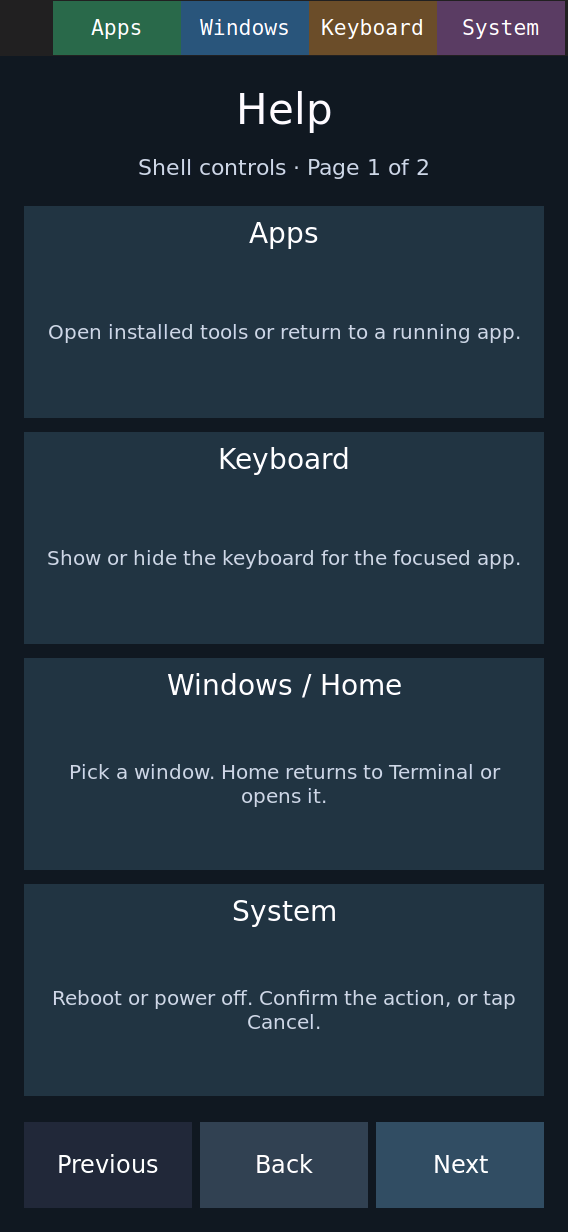
Navigation commands and the resulting page 1, page 2, keyboard-visible page 3, and Back to Apps exercise the two-page normal layout and three-page keyboard layout. The injected device was made from the real controller’s evemu description; it was not a real finger.
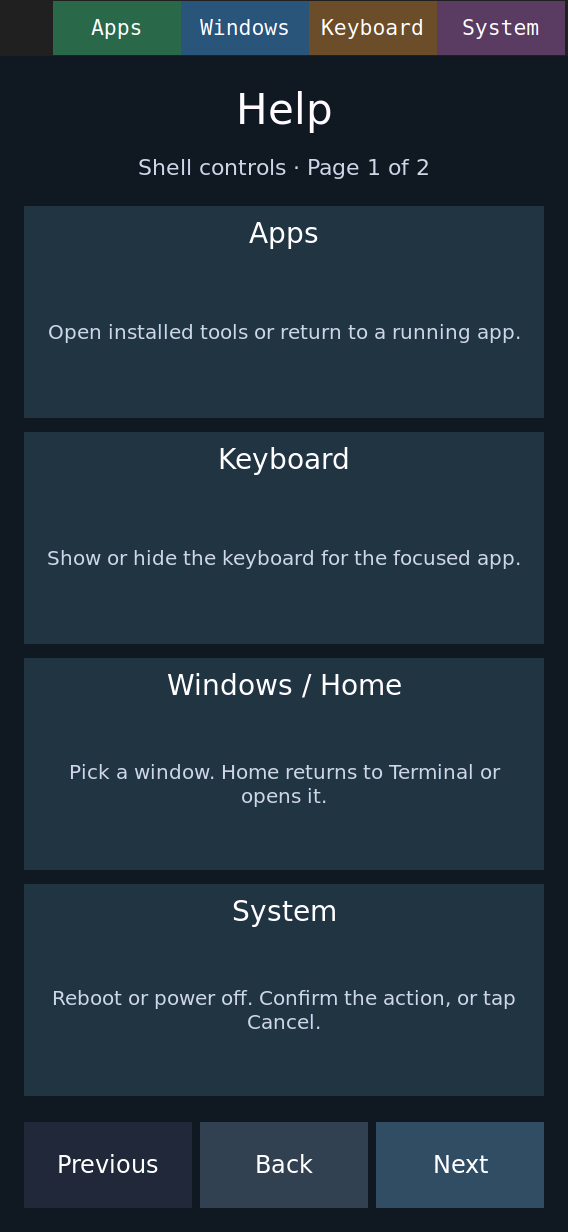
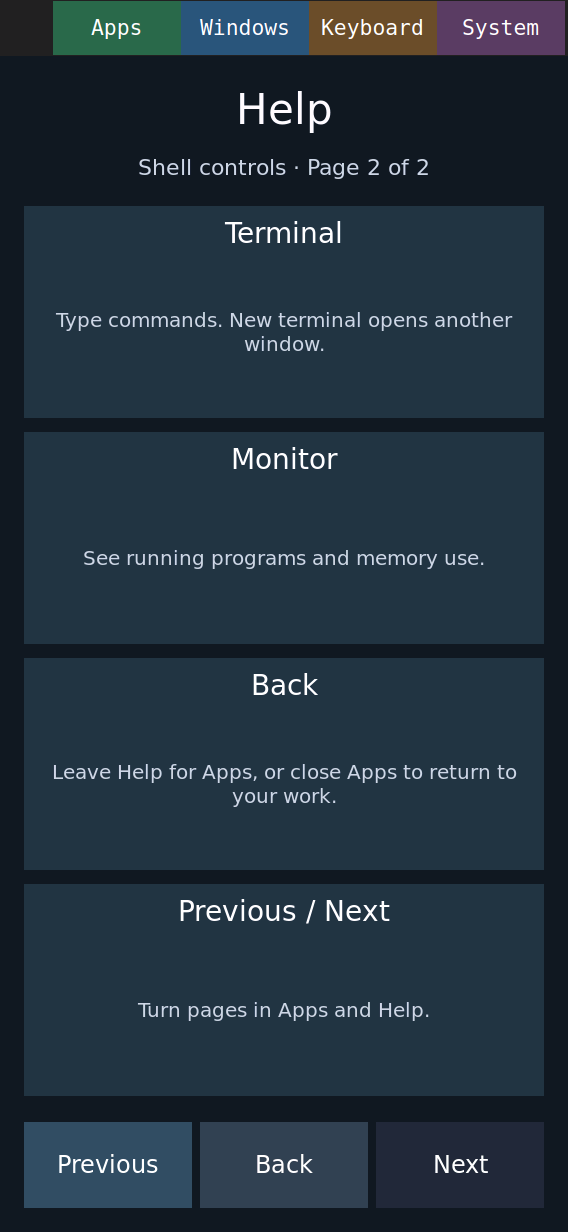
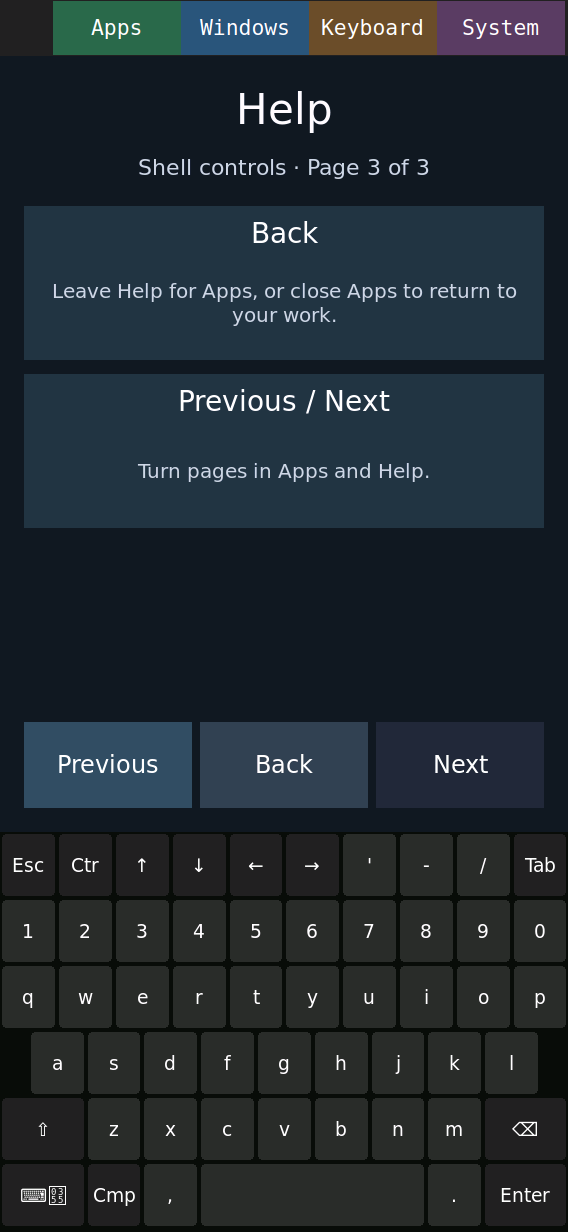
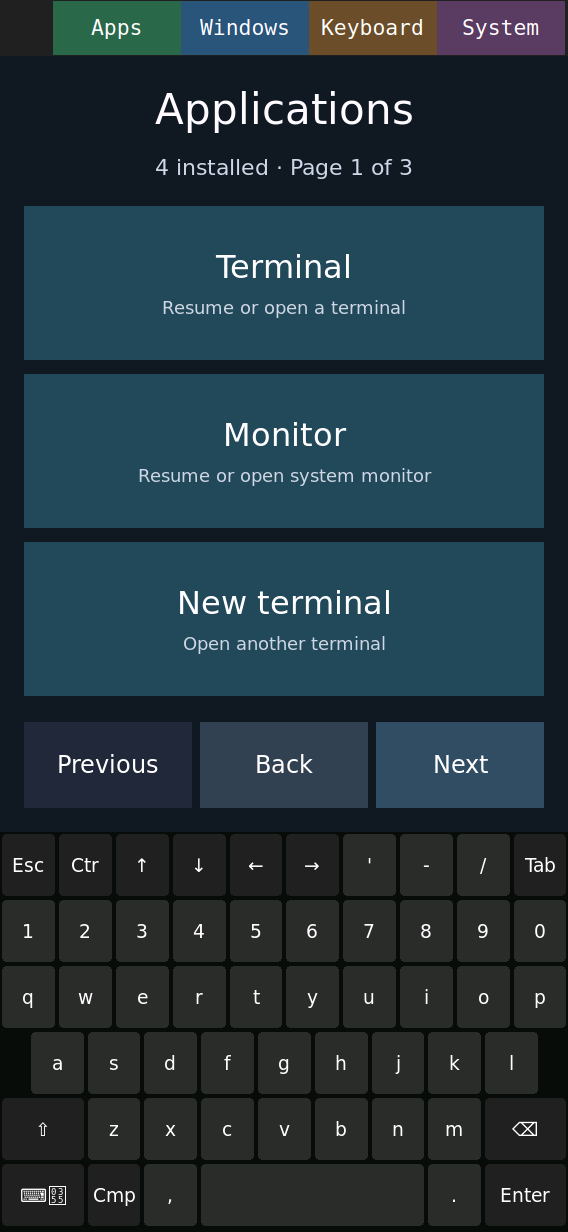
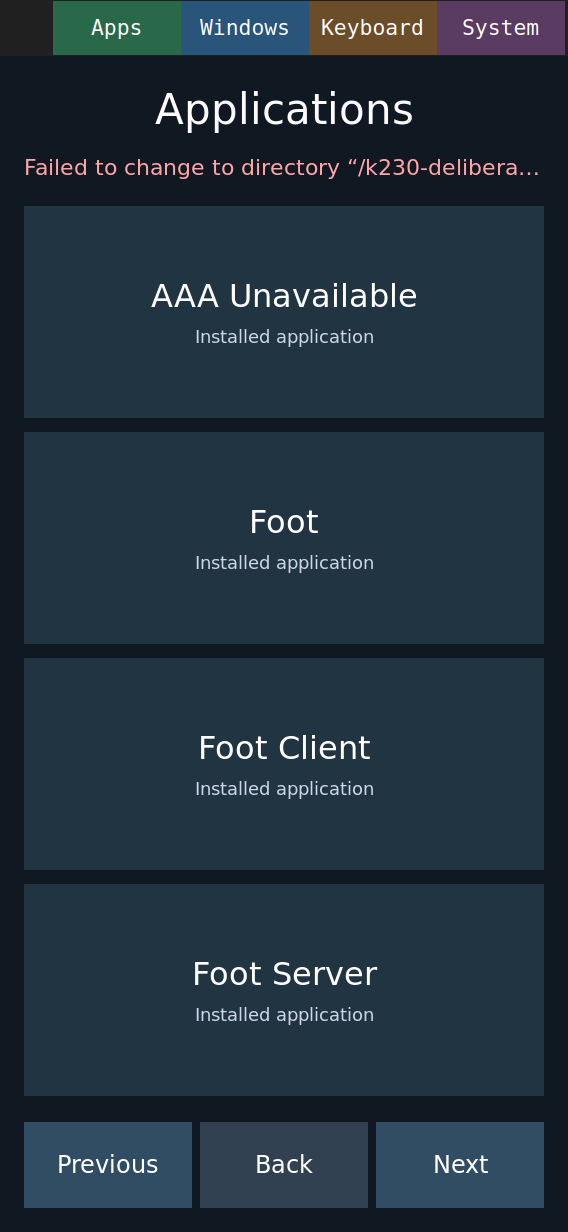
A deliberately invalid desktop entry’s working directory caused a visible
launch error, documented in the console.
The launcher remained open, Previous returned to the built-ins, and
Help remained available; Back then returned to Apps and closed
it. The fixture lived under /run, not the user’s application directory.
The empty-catalog case is covered separately by tests/test_launcher_navigation.py;
the board still discovered four existing entries, so this is not an empty board
catalog claim.
Candidate launches
k230-editor.desktoplaunches nano withTerminal=truethrough the existing Foot bridge. The first attempt inherited/rootfrom the root test console and failed to change into that directory asshell. Repeating from/home/shell, the normal session working directory, succeeded: console, running editor. Nano process RSS was 3,968 KiB.nnn.desktopretains the upstream terminal entry. The temporary fixture used its exact store executable while it was not yet installed in the system PATH. Console, card, and running browser show the result. The starting home directory has no non-hidden files, hence the empty list. Process RSS was 2,688 KiB.
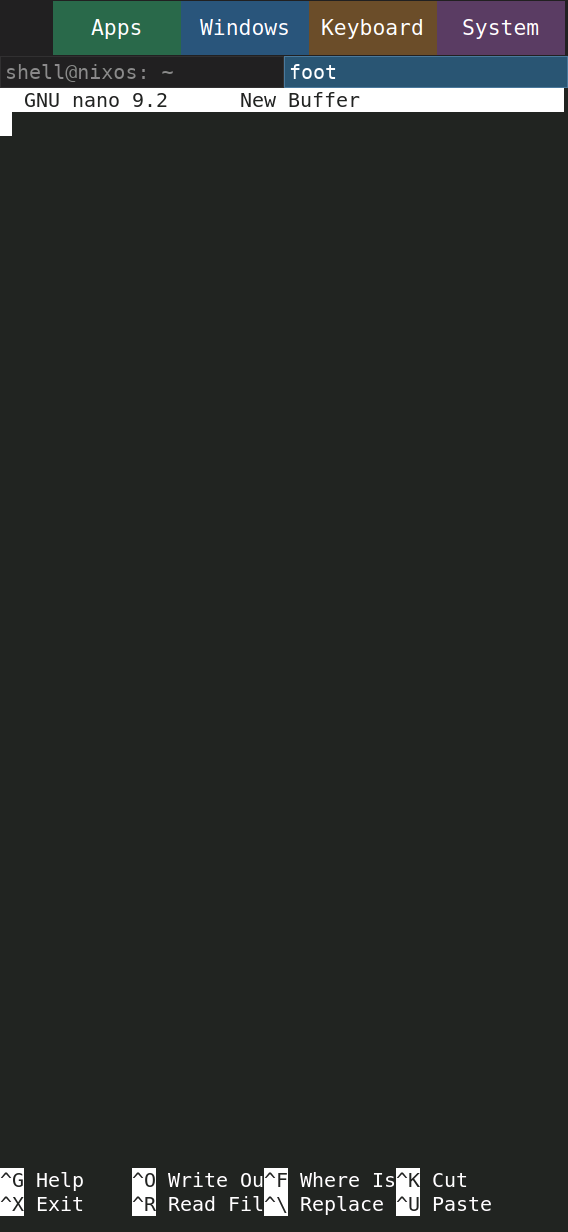
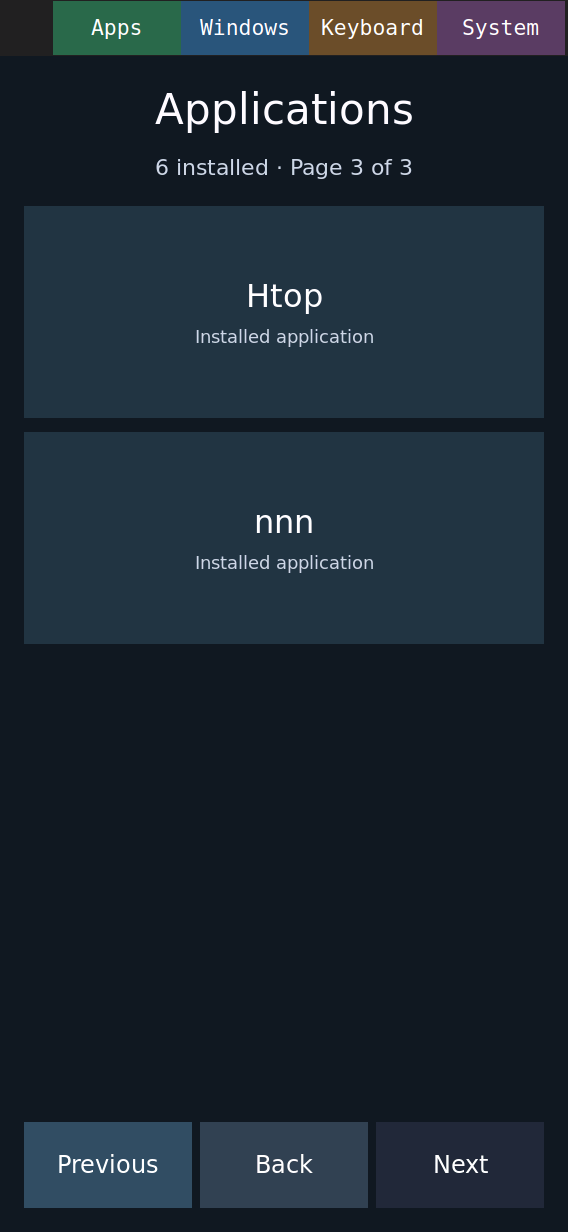
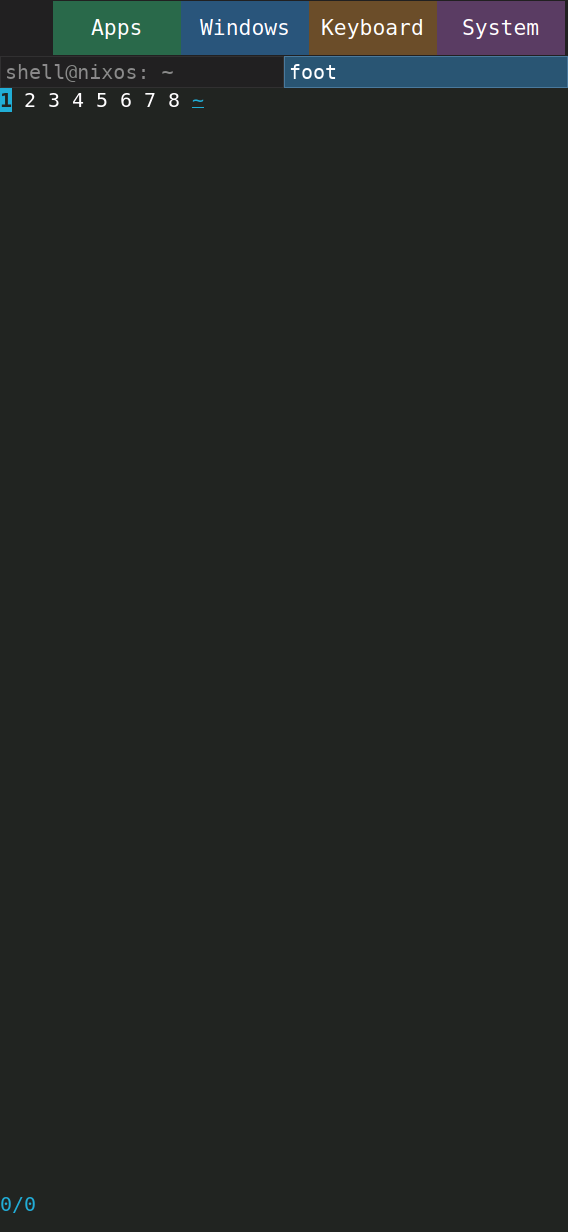
The on-board timestamps around the injected activation and a 0.2-second wait span 0.682 seconds for nano and 0.663 seconds for nnn. These are process-observation upper bounds including the injection helper and deliberate wait, not isolated application startup or physical display-latency measurements. The earlier failed editor attempt is retained rather than represented as a successful launch.
All three candidate packages cross-build. The closure set comparison in
docs/evidence/offline-app-candidates/closure-deltas.json supports nano + nnn:
nano adds no paths to the existing closure; nnn adds 441,408 NAR bytes; lf would
add 5,788,696. The rejected lf candidate has not been timed on the physical board.