Applicable theme consumers completed — 2026-10-10
The generated appearance now reaches actual mouse hover, existing focused text fields, ordinary shell typography, bounded visual spacing, and overlay scrims. The 102-field compatibility inventory names an actual consumer and reason for every field. This supersedes the implementation gaps recorded in the October 2 partial font/spacing checkpoint.
The real Rust renderer and C appearance receiver passed 497 host test cases:
436 Rust library, 13 C receiver, 7 rendering/inventory, 14 activation and 27
transaction cases. One unrelated Rust diagnostic remains deliberately ignored.
All targets compile with cargo check. Commands, source hashes, UTC record time
and capture hashes are in host-results.json; raw logs are
committed beside this record. The new tests verify actual painted pixels,
transformed pointer coordinates, cache invalidation without activation, focus
priority, gradient/alpha scrims, bounded metrics and C rollback/rejection.
Reviewed production host captures
These six pairs use the pinned packaged Catppuccin report/appearance, the real AppearanceReceiver and production RendererCache, Cairo and Pango. Service/app fixtures are identical in each pair. The adapted fixture sets base-size 15, caption-size 13 and spacing scale 1.25; it never edits upstream theme bytes.
| Existing surface/state | Baseline | Adapted |
|---|---|---|
| Settings | baseline | adapted |
| Settings mouse hover | baseline | adapted |
| Drawer focused search | baseline | adapted |
| Home | baseline | adapted |
| Help | baseline | adapted |
| App actions | baseline | adapted |
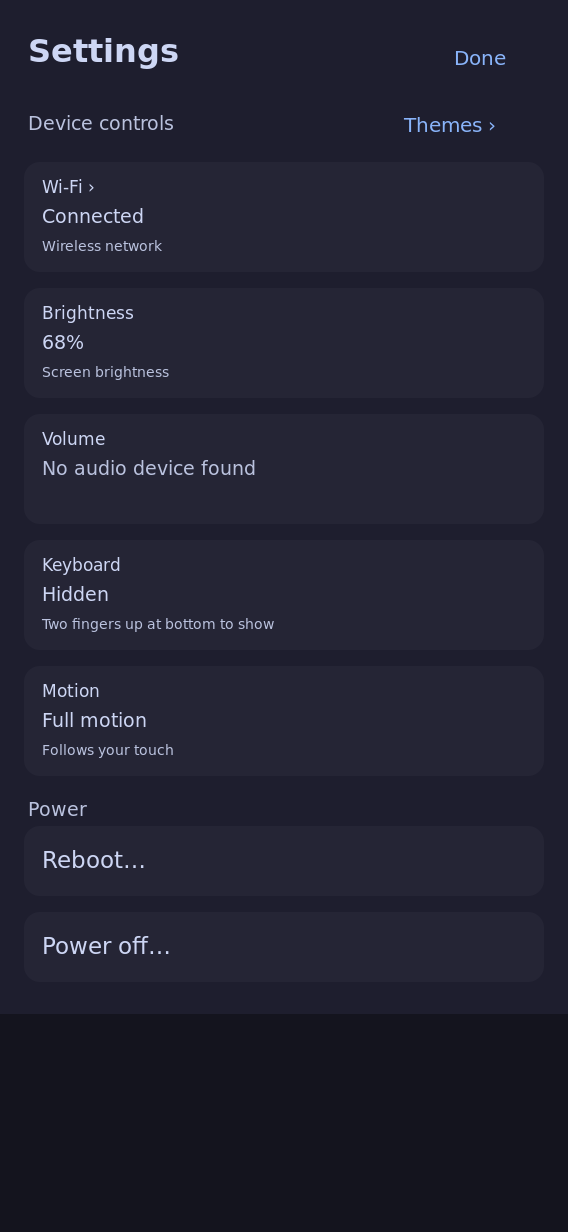
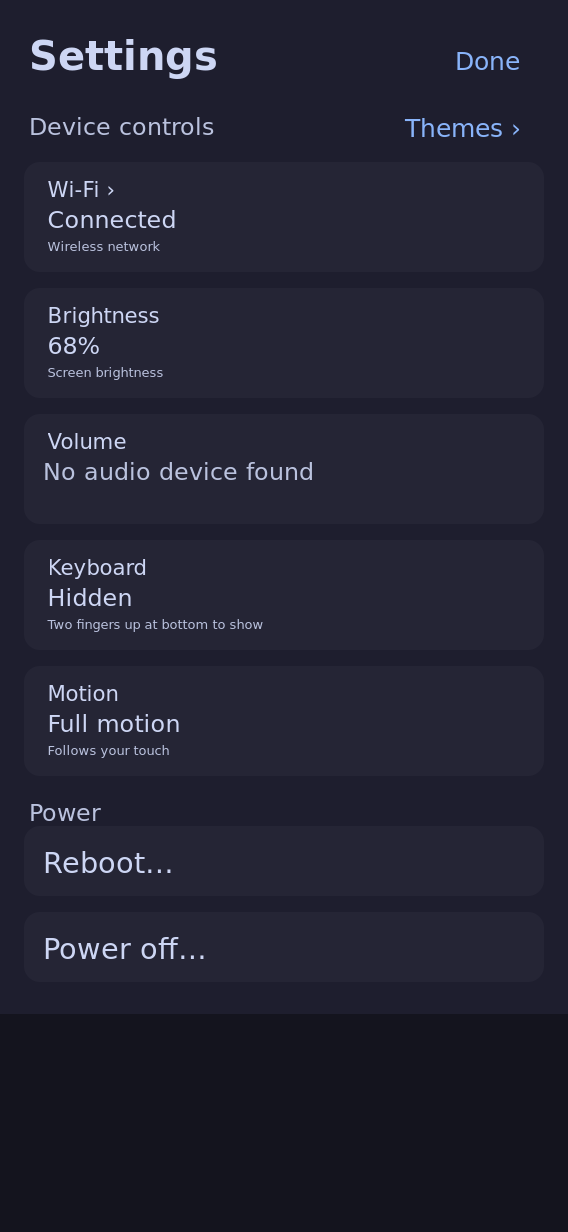
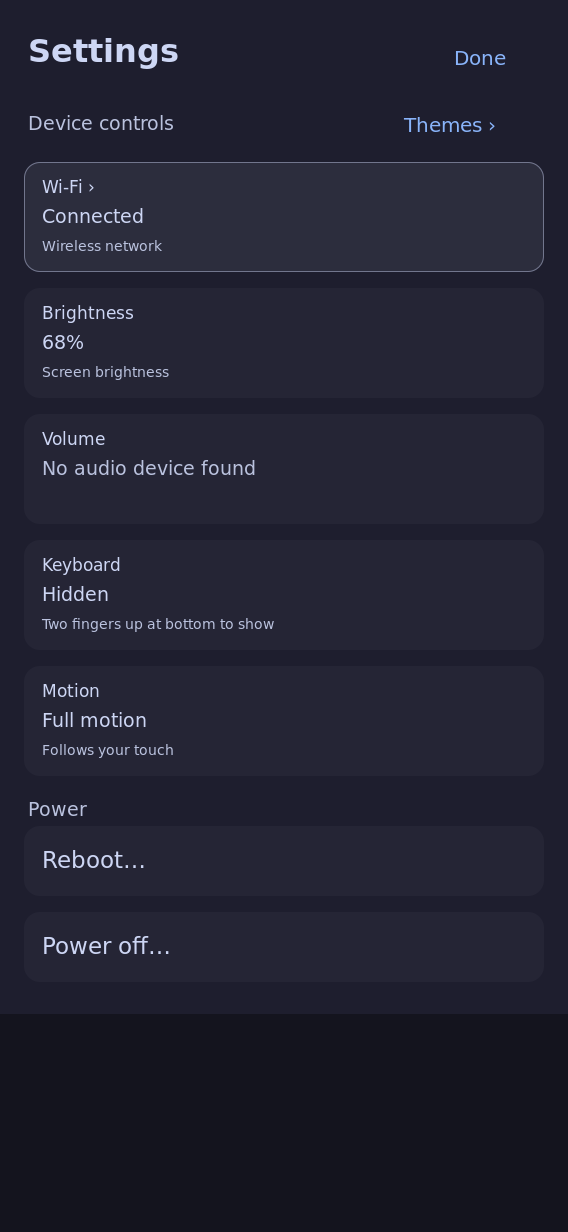
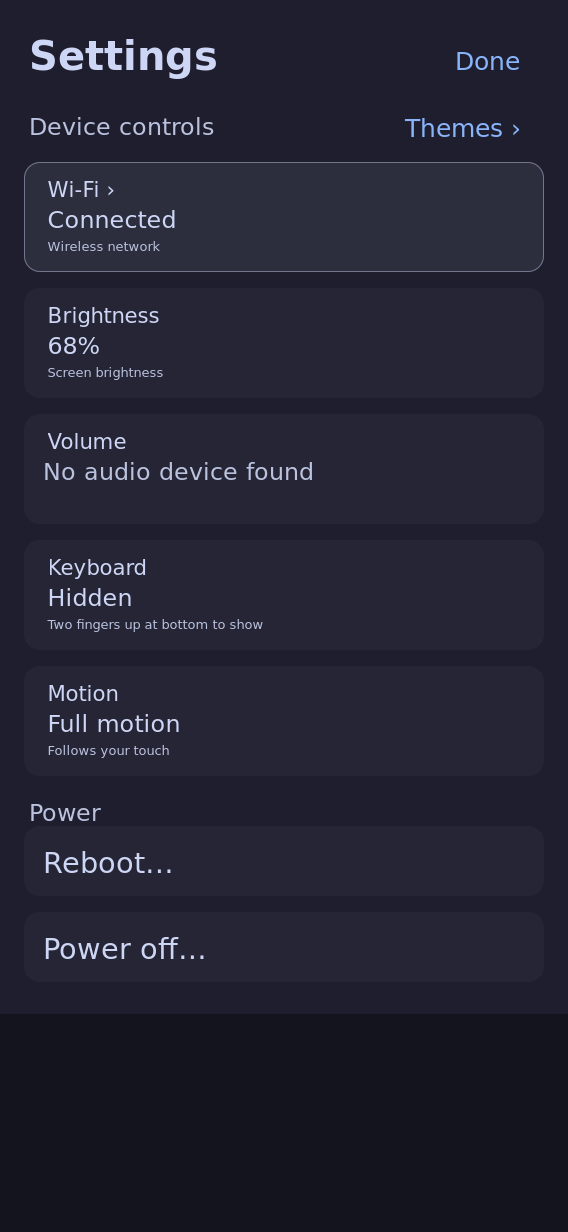
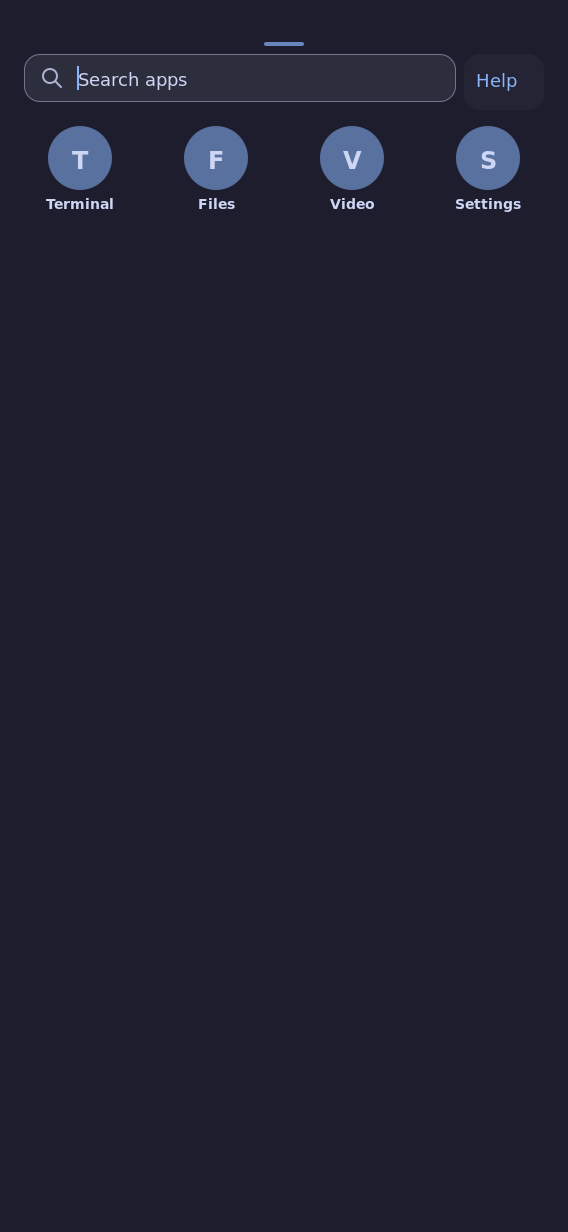
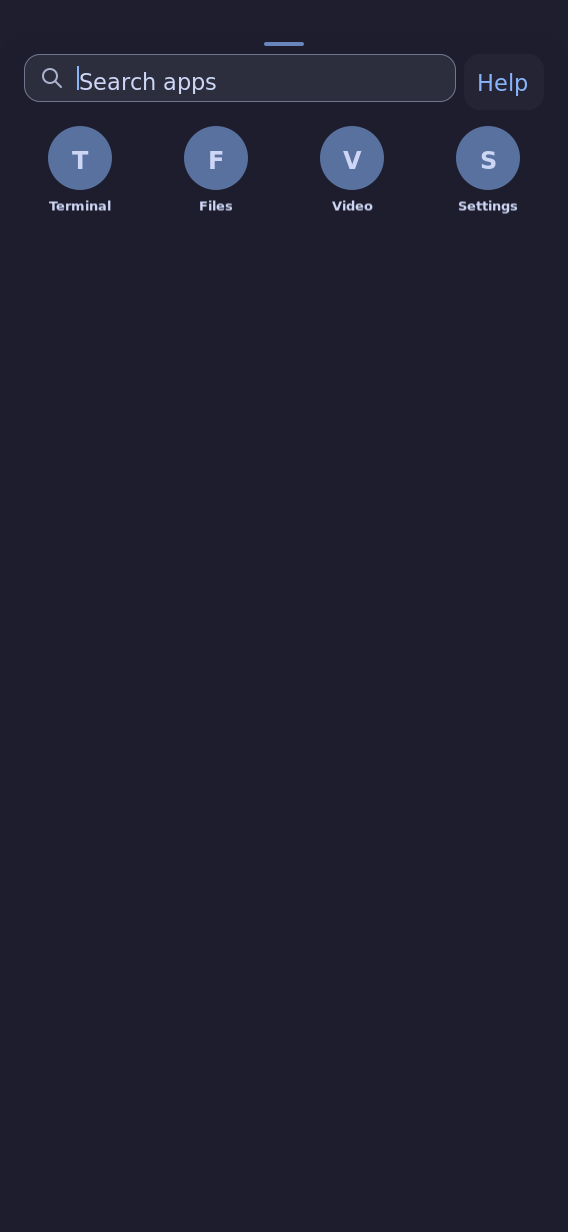
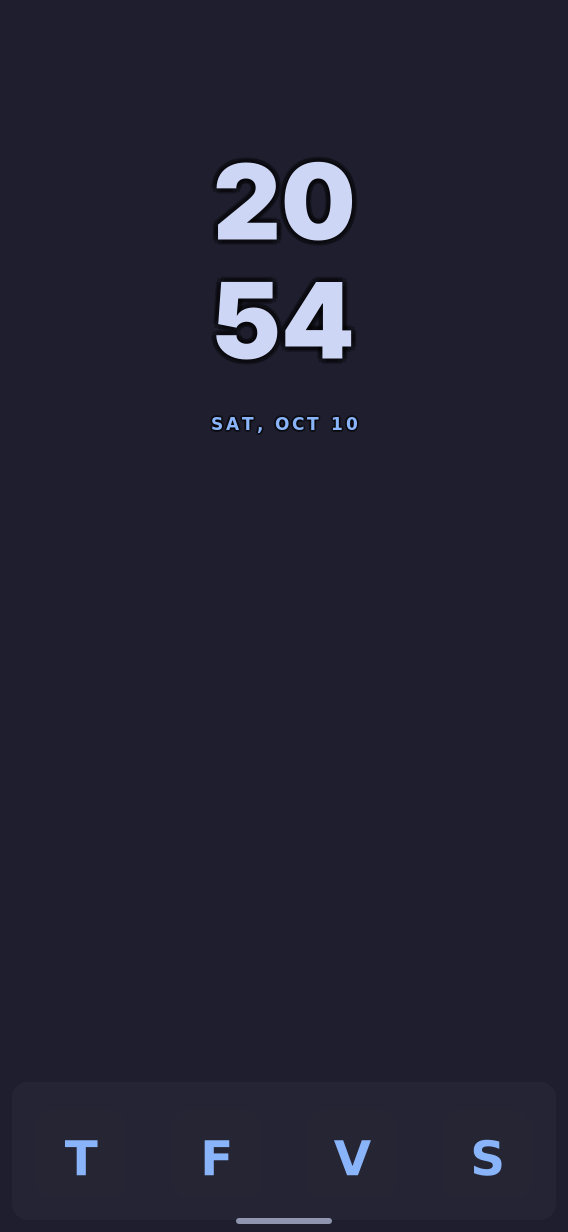
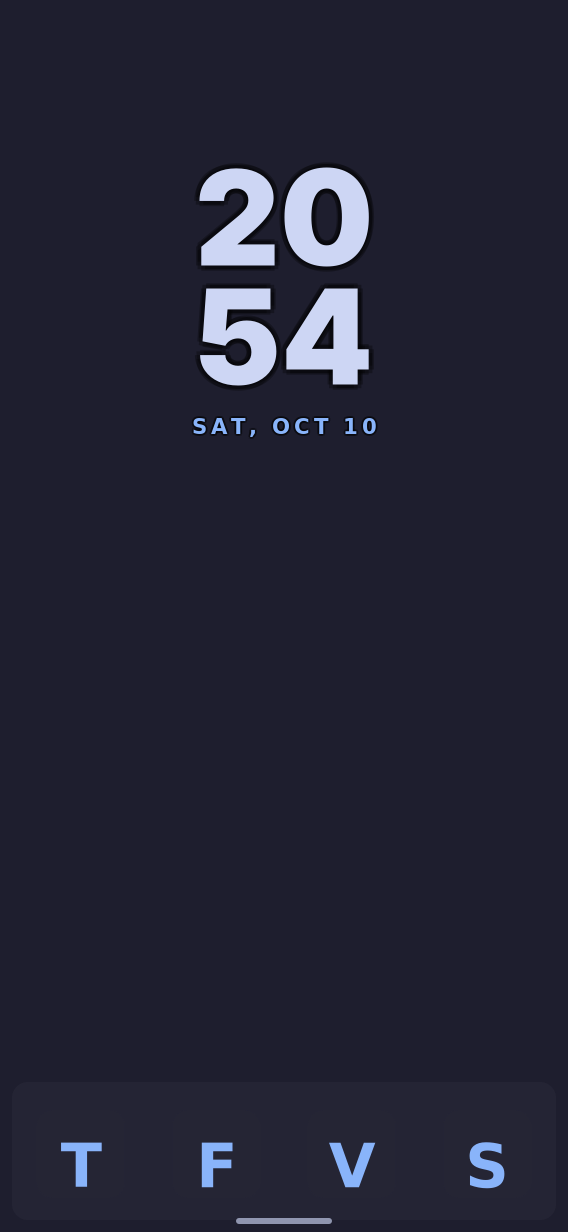
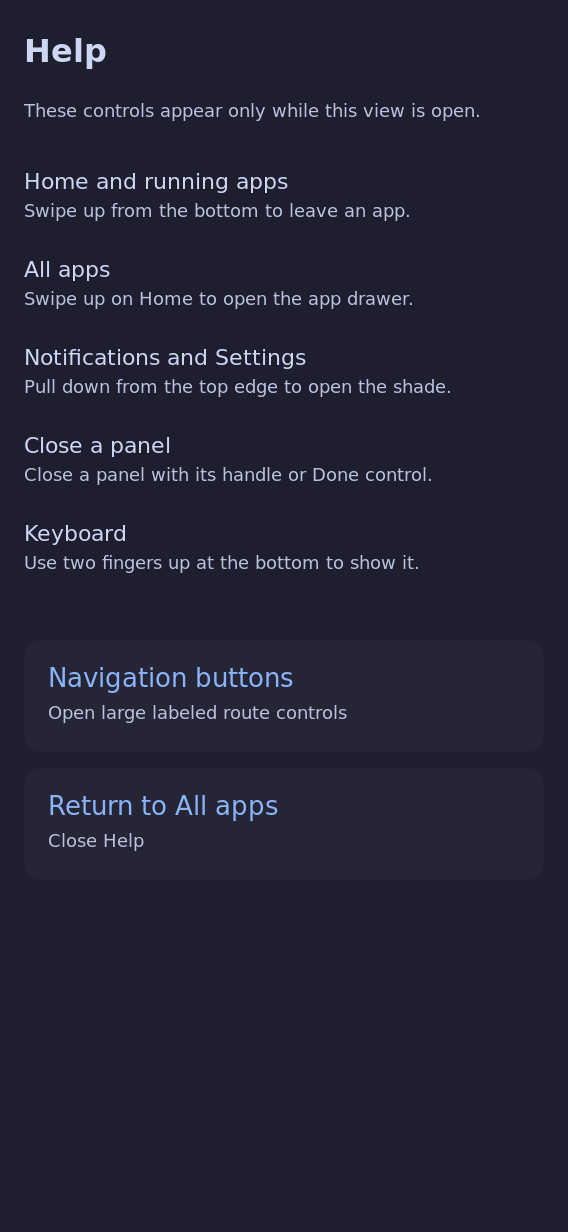
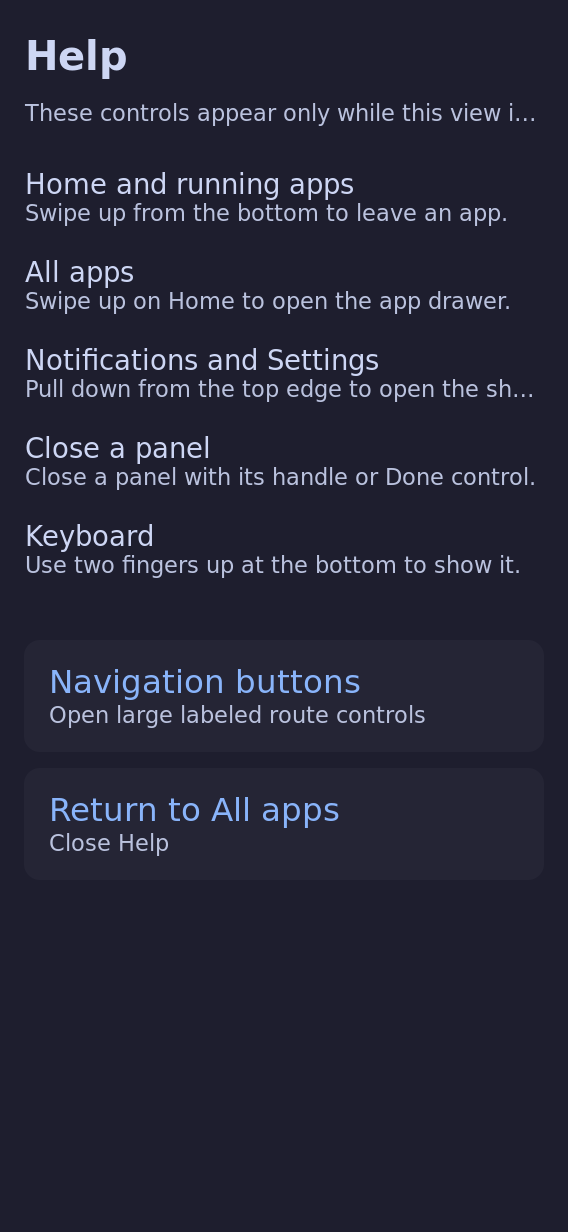
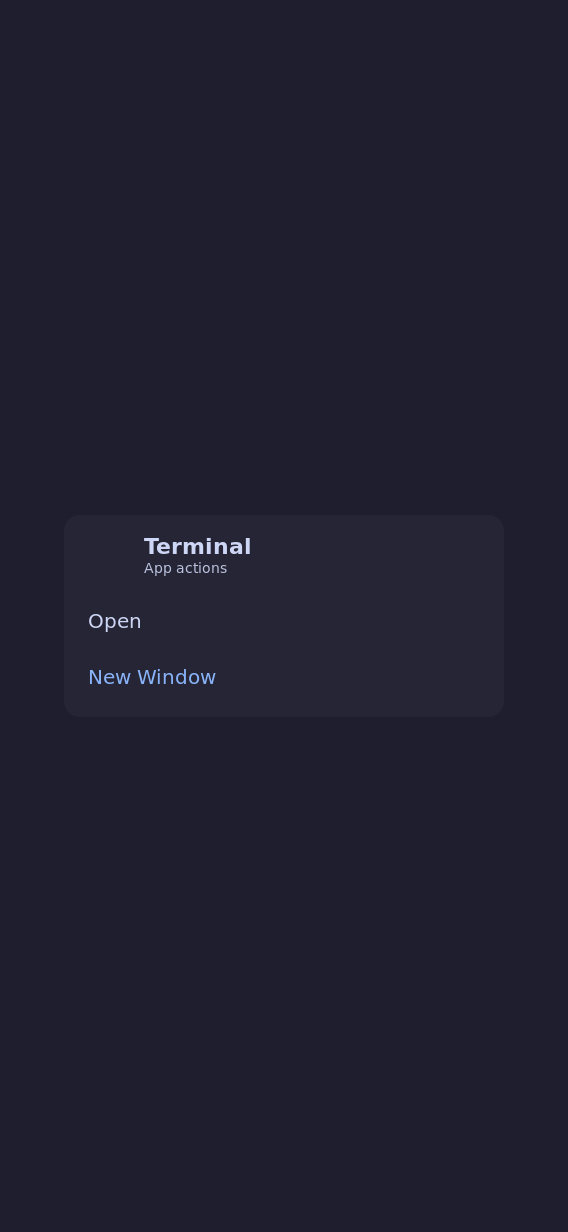
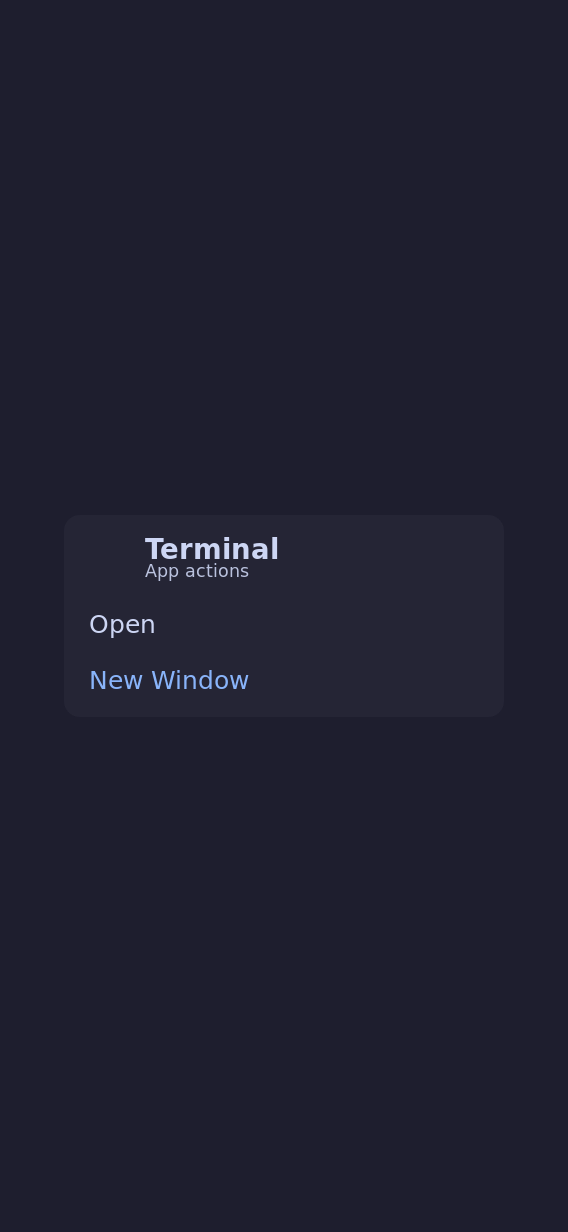
Reviewed at native 568×1232: Settings rows, drawer search/labels, Home clock and dock, Help actions and app menu remain within their existing bounds. Enlarged long Help descriptions use the existing end ellipsis; this is a documented fixed-layout adaptation. Captures with letter icons exercise recognizable missing-asset fallback, not icon inheritance. Actual inherited icon evidence remains drawer/card generation.
Adaptation and limits
Rust stores metrics on each render target, so a preview cannot alter another renderer. Base font is expressed relative to the upstream 12 default and bounded to 0.8–1.25; ordinary small labels retain an 11-pixel floor. Existing Settings/caption role bounds remain. Spacing combines the explicit scale with base font only when scale-with-font is enabled, also bounded to 0.8–1.25. It affects visual text insets, Home/drawer label gaps, widget padding and card header icon/text separation. Gesture zones, touch rectangles, panel dimensions and fixed grid/row positions remain the handheld layout. C card labels use the same bounded factor and are invalidated with the appearance generation.
Hover is driven by real Wayland pointer coordinates and never selects a tile or activates a control. Focus belongs to existing drawer search, password and folder-name editing states. Hover/focus retain full authored color brushes, alpha and per-side outline widths. Ordinary idle outlines, persistent launcher selection and shell text-range selection remain deliberately unavailable in this accepted layout. The compatibility inventory explains each omission. Launcher/menu scrims retain authored gradients and alpha; image-picker side scrims multiply authored alpha by the existing carousel blend, with the centre slice undimmed.
These are host captures, not new panel observations. The existing operator acceptance/waiver applies; additional real-finger recording and latency collection are not required. Individual physical typography/spacing cases, static CPU/RSS/decode costs and full fresh-HOME boot remain UNVERIFIED. Installation and published revision are separate records; successful host tests do not imply deployment.
Cross-build and publication
The source at 3a1a3e51d78f8a642677d28918fb018cad3de971 cross-built both
handheld-shell-rust and card-shell successfully under the exclusive build
lock: six changed derivations, no kernel or unchanged graphics rebuild. Exact
store outputs are in build-result.json, with
build.log and build-plan.log. Both selected
outputs/derivation requisites and the prior verified input farm are retained
under a durable GC root; retention.log records the new farm.
The build slot is released. No board or serial reservation was taken.
python3 scripts/build_site.py passed for committed compatibility revision
ef55c4d7e1fd22e12890a744903c06b74ae45572: 687 pages, 18,328,245 bytes,
58.66 seconds, inside unchanged 32 MiB/120-second budgets. The
complete compatibility report
retains source/license attribution, captures, layout adaptations and limits.
Publication receipt verifies HTTP 200 for the work board,
compatibility report and consumer evidence at landed revision
923c6a9708a23ddbb8cff4b577cf0741c68580aa.
CI run 38104005765
passed both build and Pages deployment.
These new packages are cross-built, not newly installed on the board. The
already installed accepted system is the separately recorded coherent-shell
candidate; no new physical consumer case is inferred. A later board deployment
must build the matching nix build .#kernelMainlineDrmShellBootFiles bundle,
then use the guarded stage/install workflow in
combined-board-candidate.
It must bind any install qualification honestly to that new candidate. This is
a separate deployment action, not a renewed request for waived recordings or a
gate on the accepted parent archive.
Subsequent matching installation — 2026-10-10
The pre-installation limitation above is superseded by the completed matching deployment. The matching bundle was built and installed with unchanged kernel/Image/initrd, root rollback retained, and actual untouched ordinary boot observed. Exact new Rust/Sway/helper identities, four active services and active panel output are committed there. The operator’s standing collection waiver is recorded as userspace-update authorization, with no new finger or pixel claims. Existing UNVERIFIED individual physical cases and workload measurements remain.